Showing posts with label GAFE. Show all posts

Tuesday, February 23, 2016

Lesson: The American Dream Deferred - The 1950s African American Experience

Digital media and primary sources from the Montgomery Bus Boycott introduce our students to the civil rights movement in America. As historical problem solvers, we joined the ranks of Dr. Martin Luther King Jr and Rosa Parks--as well as Claudette Colvin, Bayard Rustin, Jo Ann Robinson, and Virginia Foster Durr... Names we may not (yet) know, but probably should.


We began our inquiry (historical problem solving) with two pivotal questions:

1) "What might this poster suggest about the people and organizations behind the Montgomery Bus Boycott?"

2) "How might an act of civil disobedience, like breaking an unjust law, spark a nationwide movement?"

A demanding challenge and a hard-fought victory:

The students' responses were thought-provoking and very well reasoned. Their ability to cite specific evidence is emerging, and as our exercise continued, they confidently referenced details from both the bus boycott flier as well as Rosa Parks' booking photo and accompanying question.

It gave me such pride to share this experience with our students' corporate work study supervisors--approximately twelve visitors happened to be on tour while we were discussing the warm-up questions and image above.

The ensuing scene was inspiring, magical, and reminiscent of a Morgan Freeman movie about a school "turning lives around and opening hearts in the process". The students and their supervisors took turns playing off of each other, bringing up points about the style of the poster, the size of the font, the homemade details... Truly, it was one of those moments that make you feel the electricity that comes from engaging in the learning process. 

Our students collaborated in groups of up to three people, working through a textbook entry (A) and four additional primary sources (B-E). 

In each round, they constructed a claim addressing the question "Why was the Montgomery Bus Boycott successful?"

To answer this, our students needed to cultivate reasons that the artifact used to suggest that the protesters would prevail and specific evidence that they could cite in support of their claim.

Again, working with primary sources poses a far greater challenge than textbook entries, as students must construct meaning and place the ideas within a historical context. It's a sophisticated task that requires patience, skill, and above all else, practice.

I'm incredibly proud of our students and the work that they have accomplished. It gives me joy to share this lesson with you in the hopes that you may find the inspiration to work with primary sources and integrate this Monthomery Bus Boycott playlist into your class, too.

Digital media: 


Curriculum & teacher resources:


- Google HyperDoc: MBB Notes
(links to primary and secondary sources)

On the horizon:

Our students will begin production of YouTube videos about 1950s American life. We are collaboratively constructing claims, sourcing the best digital media and primary source evidence to support the assertions, and we will roll out our first iterations in the week to follow. It's incredible to witness how far we have come in this short amount of time together.

Invaluable resources:

@SHEG_Stanford
@PSNTPS
@TeachingLC
@librarycongress
@pbsteachers

Thursday, February 18, 2016

Tech Tips: Advanced Search Techniques Help Students to Get the Most from Googling

Advanced search techniques are yet another #AwesomePossum way that Google helps teachers and students find and curate content.

A few years back, we used Google Image look-up to track down the artist behind the Possum with Ukulele. The artist gave us permission to use the design for our high school's anti-bullying assembly, and the little guy has been either ever since. I'm a big fan of AwesomePossums.

A few ways that advanced search techniques can be used include placing restrictions on an active search. These restrictions can be a variety of factors used to distill the best results for whatever the circumstance dictates.

-Date

-File type

-Region

-Creative Commons and other copyright licenses


Here are some helpful links to get started 

Advanced search for websites & images:

Tips on filtering search results:

Finding "free-to-use" images:

Next week, I will update this post with a YouTube tutorial using some of the advanced search techniques listed above.

-

I'm looking forward to teaching our students how to use the filters to curate images for their 1950s American Life YouTube video project. Cultural Literacy students will begin making annotated YouTube videos about the different themes that we have explored:

-The Cold War & The Red Scare

-American Consumerism & Women in the 1950s

-The American Dream Deferred: Segregation & The Start of the Civil Rights Movement

-j

Tuesday, February 16, 2016

Lesson: 1950s American Life & The Happy Housewife Archetype (+YouTube Playlist)

The past is a foreign country--historical inquiry requires a passport unlike any other: stamped with empathy, understanding, the willingness to believe that many actions were guided by well-meaning intentions, and some decisions are shrouded in ignorance. 
It is what it is. And in the study of Cultural Literacy, the past comes to life as we devour novels, primary sources, and historical accounts from experts in the field.


This past week, we continued our investigation of 1950s American life and focused on "The American Dream". Our inquiry centered upon American consumerism and the role of women in the 1950s.


Our sophomores responded to this lively discussion. It was another impressive display of teenagers grappling with the foreign-nature of historical inquiry. On more than one occasion, debate turned to pondering the legitimacy of gender stereotypes of the time and the silent dissatisfaction among many in the 1950s. 

One of our awesome sophomores, Leah, sent me a music video from the band the Neighbourhood. Her observations, that the dissatisfaction and turmoil of the homemaker in the video, resembles the discontent voiced in the Feminine Mystique and other primary sources that we examined.

Classroom Resources:
Stanford History Education Group: Reading Like A Historian
Primary Source Readings: Women in the 1950s

Videos:
Cultural Literacy Class Playlist - 1950s American Life: American Consumerism & Women
Makers: Women Who Make America (PBS) - 1950s Housewives

Collaborative HyperDoc: 

Two primary sources:

Two secondary sources:

Additional Video Resources:


USA Economy in the 1950s

The Feminine Mystique via PBS Makers: Women Who Make America

The Levittown Story - America's First Working Class Suburb


Crisis in Levittown - Segregation and Discrimination

The hyperdoc and resources from Reading Like a Historian are great for collaborative learning across the spectrum... appropriate for learners of varying reading levels.
-j

Thursday, February 11, 2016

HyperDocs Connect Students to Expertly Curated Content & InspireCollaboration

Once upon a time, Chromebooks & Gogle Docs were Google certified laptops and word processors... But that was not collaborative and did not advance our mission of providing authenticically engaging and meaningful instruction. How might we get our students to share ideas, incorporate evidence, and even play off of each others insights in a way that promotes deeper learning and activating critical thinking?

The hyper doc is a steep in the right direction... It is more than a study guide--more than a worksheet. It is a repository of curriculum resources and student and insights.

Connecting hyperlinks to warm-up graphics help to extend the original lesson throughout the class period and into the next session.

In its simplest form, HyperDocs are Google Docs with connected hyperlinks that we may use to base our inquiry upon. These hyperlinks connect students to resources--such as primary sources and thought-provoking discussion topics in our learning module and links to digital media resources. There are very few limitations when it comes to using HyperDocs. You cannot embed a YouTube video in the document, but you can easily link to a playlist, video, or other expert sources.

A screenshot of a HyperDoc created to correspond with a look at the image of the happy housewife of the 1950s.

When a student selects the hyperlink writhin the document, it automatically loads the accompanying source: PDFs, digital media resources, additional Google Apps, etc. This makes it user friendly and saves time by pairing online resources in a way that students can use, access, and review. The onus is on the student, yes... And it is just good practice! If we want to help our students to succeed, we can equip them with smartly designed organizers and guides such as HyperDocs.

Once a student opens a HyperDoc, s/he can make a copy of it and share it with partners.

I like to organize the written content using tables: this is especially convenient for students working on their phones, as tables slide from left-to-right. This helps to preserve the integrity of the document while improving the functionality of the text box when working on a small screen. Perfect for working on the bus or in an environment where you don't want others to know that you are doing your schoolwork.

Shocked by this??? To some teens, taking free time to work on your school laptop is a pathway toward being a social pariah. "Playing on your cellphone", though, is perfectly acceptable. Don't judge... We were all teenagers once upon a time and we had formal and informal codes of conduct that we had to abide by.


A few thoughts on how interconnected learning helps us to stop sweating the small stuff:

Far too often, it's matters of organization that hold teens back from reaching their innate potential and keep them from finding academic recognition. Full disclosure-- I do not subscribe to the, "Well, these kids have to learn to take responsibility for organizing their materials..." lecture series. 

Please know that although organization is one of many skills that are prized among students, it does not necessarily translate into an accurate measure of a student's learning or capacity for understanding... 

Deductions on the basis of organization and an acute lack thereof do have a way of severely hampering students' overall scores, affect students' perception of themselves, and don't always build character in the desired way that a well-meaning teacher intends. I'm not saying that students do not need to work on this among many skills--but I would rather give students digital access to everything on demand and spend more time and energy on critical thinking and creative problem solving.

HyperDocs help to encourage meaningful collaboration--a free exchange of ideas and a way to free up students' time so they may devote more energy to building, making, and creating... It is a win-win!

Tuesday, February 9, 2016

Lesson: Sketchnoting The Cold War & An Introduction To Audience Awareness

Recently I was overjoyed to share with my students a mutual affection for sketchnotes and Soviet era art and propaganda. I should preface this post by sharing that once upon a time, I felt the wrath of a a handful teachers growing frustrated with my unorthodox style of note taking... 

I'm not claiming that kids like me were persecuted for busting-out the multi-colored pens to take notes, draw pictures and charts, and jazz-up an extra few sheets of wide-rule filler-paper. We were just misunderstood... And, what we once referred to as doodling in our notebooks has now found legitimacy in today's classroom: Awesome Possum! 

A student's sketchnote of Churchill's "Iron Curtain Speech".

I like to read speeches aloud--they are meant to be savored by the ear. I really like coupling this delivery method with the processing that sketchnotes afford. Think about it: the act of slowing down to incorporate both words and images helps students to personalize the lesson and make the take-away a very unique experience for every learner in the classroom. 


The materials for this lesson came from the unit "Cold War Culture" via Stanford History Education Group's Reading Like a Historian series. I will dedicate a future post to singing their praises--the resources are spectacular.

Above, we used an excerpt from Churchill's speech. The full text is available online--just register for a free account on the Stanford History Education Group's site. The readings come with accompanying guides, too. I incorporated the questions from the guides and used them to supplement class discussion. 

I especially liked the way that the questions prepared by SHEG focused upon audience-awareness. This is a sophisticated step for students to make--the jump from "What is Churchill saying?" to "Why is he saying it this way?" or "Why is Churchill addressing an American audience in the first place?"

The benefit of introducing a sophisticated notion such as audience awareness in tandem with a seemingly juvenile technique as sketchnoting is that the student drawn images can help to articulate this difficult concept--that the substance of a speech is only part of the equation... It's the audience's ability to receive that message that is telling.

A thoughtful illustration can bring that concept to light in a way that a developing writers' voice is still sounding-out.

To complete the analysis, I created a Google Doc note taking sheet... Because sketchnoting all four primary sources would be just too much of a good thing.

The sheet above is appropriate for individual efforts and collaborative endeavors, as with all GAFE resources. If you plan to have your students work in cooperative learning groups, dividing the readings is a must:
-Documents A & B suggest that the Soviets are primarily responsible for starting the Cold War
-Documents C & D suggest that the US shoulders the burden for starting the Cold War


Hope you check out both sketchnotes & Stanford History Education Group's resources!

-Jennifer Sylves Lanas

Note:
In hindsight, my doodles were not taboo in every single subject when I was in school. I recall making a cartoon series in high school starring my AP Bio teacher as a studio wrestler our entire class named "The (protein) Inhibitor, and his collection of side-kicks from the lab--including a cameo appearance by the fabled Three Little Pigs... And who could forget the comics I drew and posted in the Saint Vincent College Philosophy Tutor's office--Philososaurus Rex...

Lesson: Be kind to those students who color outside the lines.
You might end up reading their blog one day...

Monday, February 8, 2016

Tech Tips: Embed Google Drawings for Instant Updates to Websites & Assignments

We begin each class with a warm-up activity--students write discussion board posts, reflections, or submit questions. Our learning management system, Canvas, makes it pretty easy to set-up...

But what happens if you need to make a quick change? Do you really need to update the assignment for every class?

No... And that is one of the big advantages of using and embedding Google Drawings in your online assignments and websites.


Google Drawings can be used to combine images and text in a variety of ways. In the example above, our students used primary sources--a Cold War propaganda poster (left) and a "Duck and Cover" photograph from the 1950s (right) to write a discussion board post about "The Red Scare".

Designing engaging graphics in Google Drawings is easy--think of it as the "best-of" Paint and PowerPoint with the best image and clip art database on planet Earth. I like to create a basic template with which to work and then "make a copy". This way, I can replicate ideas and plug-in new question prompts and images. 

See previous posts tagged GAFE to see examples: the PEEL paragraphs on writing about primary sources is an great starting point. I used one template to make a half dozen unique writing prompts, and posting a "view only" template enables students to take the idea and customize it with their own visual.

To help you to get started, I've posted a few how-to tutorials below. Using Google Drawings and the publishing tool is a true time-saver that enables revisions to be made and updated with no effort at all.


Check out this quick video on publishing a Google Drawing and embedding it on a discussion board or website.


Check out this video showing you how changes are automatically updated once a Google Drawing is embedded. No matter how many times you paste the code on a number of sites and assignments, you will never have to update the post. Any revision made to the Google Drawing is automatically recorded.

Think about all of the times that you "finish" a document, only to revise it thirteen times after "you're already done"... Okay--maybe that is my own personal OCD, but I can't be alone here!

At any rate, this makes it that much easier to make changes in one place and have the updates materialize everywhere. Now that's how we rapidly prototype in style!

Friday, January 29, 2016

Creative Synergy: Good Partners In Crime & Adventures in Curriculum Hacking

Freshly picked ideas are worth climbing to the highest branches. Luckily, we need not always scurry up a tree, but rather we can find inspiration in much closer confines. Today's post is about the brainstorming and spitballing that makes classroom magic happen.


Cultural Literacy at Holy Family Academy

As part of a dynamic duo teaching Sophomore Cultural Literacy at HFA, I work closely with my partner in crime and co-conspirator, Ro Vigilante @vigilantewords. Together, we integrate American literature into the cultural context of 20th century American history and culture. 

This means that the students are truly developing a sense of the world in which they immerse themselves. In a way, we develop a taste for what it was like to live within the world that once was--to test its boundaries and limitations... To tackle it's challenges and embrace it's opportunities. 

For example, our exploration of the 1930s demonstrates a good mix of complimentary content, skills, and dispositions needed for students to connect with the world of the past, and engage the present moment via 21st century skills and design thinking.

Ro selected a bold play, Clifford Odettes Waiting for Lefty. Together we conducted a table read of the play--I thought this was neat on so many levels: Ro has an extensive background in theatre, so the students experienced Ms. Vigilante not just in her teacher costume, but as a real person, passionate about drama and the arts.

On the heels of this discussion, focusing on the nascent labor movement, a push to unionize, and the plight of young people facing a bleak and uncertain future, we transitioned to the Works Progress Administration and the Alphabet Soup programs designed to get us out of the Great Depression. 

Instead of focusing on content alone as in a traditional history class, we looked closely at the principles of human centered design and embarked upon a collective journey--project based learning and role play. Our students explored the way both the Depression and WPA affected the lives of real Americans. 

Want to learn more? Check out my blog post on using the principles of design thinking to develop Depression Era persona profiles. There's a groovy YouTube video of student perspectives on the making of the persona profiles, too.

The tech skills that we acquired using GAFE and our knowledge of the Depression helped students to build persona profiles. This also helped us to focus our attention on the disposition critical to being a good amateur historian: empathy. 

After students shared their work and posted their persona profiles to our learning management system, they recorded reflections discussing the critical need for empathy when embarking upon a venture such as this. Our students really developed context spanning the bounds of time, geography, race, ethnicity, and socioeconomic status. Where else could all of this be possible but in Cultural Literacy, an integrated classroom.

Inspiration comes in many forms... It helps to have a good partner and to work at an innovative school that empowers teachers to have the creative confidence to "go for it" and take their moonshot ideas from the drawing board to the classroom. Needless to say, I have rediscovered my teaching vocation at HFA this year.


At my former school and alma mater, Trinity High School, I worked closely with a cohort of teachers whom happened to be my lunch buddies, too. In a public school, there are fewer opportunities to modify the curriculum, unless you get the chance to write curriculum. 

I took advantage of this offer when designing the curriculum for AP Lang & Comp a few years back. Last year I shifted gears again, when I jumped at the chance to incorporate 21st century tech and active learning strategies in the 9th Grade Academy. This lead to a bit of curriculum hacking and creative use of resources to build a low resolution Makerspace in my classroom. 

First, it should be noted that freshmen are in a precarious state of knowing all of the answers and being terrified that they will be exposed for not having all of the answers... They are miniature versions of the juniors and seniors that I taught for years, only more malleable. I jest... But with lots of elements of the truth.

In the 9th grade academy, there were no opportunities to rewrite curriculum, but as previously reported, plenty of chances to "hack-curriculum " existed. For instance, Vonnegut's Harrison Burgeron was teamed up with NPR stories about an autistic classroom and their iPad band... The classic short story The Most Dangeroous Game was coupled with a podcast on street violence and a gang of teenagers on Long Island profiling and hunting Latino youth.

My students, predominantly Middle-class teens living in a rural suburb of Pittsburgh, were transfixed. Their ability to make relevant connections to both fiction and the new media that I presented them with skyrocketed. From here, we began to supplement the existing curriculum with digital media that highlighted the relevance of the text. It was 9th grade English remixed and reimagined... 

The addition of digital media and relevant, real world content transformed a short story unit into a decisive turning point in our classroom--to work within the confines of curriculum and Common Core Standards familiar to all public school teachers, but find ways to remake learning for our students.

Again, it goes back to having good partners--people that you can trust with your both your heart and your thoughts: because for teachers, we live a thousand lives within our classrooms, and the spillover into our personal world has few boundaries. 

Case in point: I keep tablets and post its around the house (and in my car's cup holder) to jot down ideas for school--I happen to be blogging at the stove on a Friday night, seasoning a pot of chili...but duty calls! 

Yes, and... It comes down to this: To be a teacher is to be fully alive in your vocation. For you and your students are on a path of learning and discovery; it was written in the eternal dream of God. Your mission is to author that story for future generations. A future of wonder and possibility.

Thanks for looking back with me... 
There are so many of my former colleagues that I wish to thank--and maybe that will be a post down the line. But I really want to tip my cap to special Ed teacher and my partner for over 4 years Jen Rakoczy, my best friend across the hall and Empress of Empathy Diana Denman, my Chewba writing creative consultant Swarrow, my Pirate game companion and the golden voice of Trinity Athletics Matt White, my difference-maker/ keeper of perspective and Frida Khalo fan club president Marna Day, my trifecta of oracles of insights at the far end of the school Erin Helmkamp, Nicole Welch, and Gretchen Mountain, my history pals who always encouraged me to brainstorm about World Affairs Council and to bridge the gaps and help students make the connections between our two fields--Mary Ellen Jutca , Joe Dunn, Lou Majoris--and my carpool partner and rogue educator in constant search of ways to improve educational practice and get kids to actually speak another language "German Josh" Baringer, aka Herr Bear.

These folks, as well as a huge cast of characters from all over the district, helped me to brainstorm some of the most interesting and creative projects for our students. I loved my time at Trinity and I grew so much as a watched eight classes of students graduate... I am forever grateful.

So, find your tribe--in your department, in your school, in your world. Next week, I'll write about online PLNs via Twitter.

Wednesday, January 27, 2016

Field Based Learning & Digital Media Expand Our Networked Learning Ecosystem

Students love to use social media to share their opinions... They also use smartphone apps to make the most creative digital media mash-ups. So, how might we leverage these powerful tools to get our kids to tell the story of their learning when the scope of their learning takes them well beyond the four walls of the classroom? 

Let's take a closer look at a recent Holy Family Academy Field Experience - Our day at the Heinz History Center in Pittsburgh, PA. We toured four floors of exhibits, including:
We Can Do It! - WWII Exhibit
Pittsburgh: A Tradition of Innovation
The Western Pennsylvania Sports Museum
From Slavery to Freedom
Mr. Rogers' Neighborhood

The diversity of topics and sheer size of the exhibits at the History Center made it a fast-paced day of student inquiry and exploration.  On each floor, students stepped back in time and came face-to-face with artifacts from our collective past.Students were encouraged to "live-tweet" their adventures in learning. Students focused on topics that they found particularly intriguing. For instance, in the photo above, Frank is taking a snapshot in the Western Pennsylvania Sports Museum's Trophy Room. The medals, trophies, pictures, and awards are an impressive display of the fruits of hard work, dedication, and the age old edict, "practice makes perfect"!Another approach to telling the story of our learning is the option to use Google Slides, Google Drawings, or smart phone apps like Pic Collage to capture the awesome artifacts and exhibits that captured our attention. Students snapped photos in each of the exhibits to make postcards to digitally send to friends, family members, and teachers.  How to create a postcard using Google Slides:- Create a new Google Slide Deck
- Insert an image as the background of the title slide 
  - Images can be uploaded from students' phones or students may select images from Google: In our case, I asked the students to use photos from the History Center's expansive digital archives.

- Format the text on the title slide in any creative manner:

  - The student objective is to become a "graphic designer" working for the Heinz History Center & to create a postcard that is both beautiful and informative
- Create a second slide and format the text so that it appears as the "letter" that one would write when sending a postcard to friends, family, or colleagues.
  - Have students write a thoughtful letter to friends, family, HFA teachers or administrators, or their Corporate Work Study supervisor.
- Send the postcard to its intended recipient by clicking "share" and entering that person's email address.
  - Be sure to check the share-settings: For something like this, I recommend that you give the recipient permission to "view" or "comment".

Behind The Scenes Videos - Women in WWII


When I went to the Heinz History Center to "scout-out" the exhibits and coordinate this field experience, I was fortunate to hear museum curator Leslie Przybylek talk about how J. Howard Miller's iconic "Rosie the Riveter" poster was designed to boost morale among the female employees of Westinghouse. The Westinghouse Corporation was a major employer in the Pittsburgh area during WWII. In fact, the architectural marvel, the Westinghouse bridge was a known target for proposed Nazi airstrikes and explosives. The bridge spans Turtle Creek, separating the two powerhouses of the Mon Valley--Westinghouse & US Steel's Edgar Thomson Works.

On a personal note--in my family, three generations of immigrants and their children lived by the edict "You work hard and get yourself a good job working for Westinghouse or in the mill." That edict held true for many families before Pittsburgh's economy diversified to include "eds & meds" and a tech-centric culture of innovation.


Curtiss-Wright was another employer hiring thousands man and women in the Pittsburgh area during WWII. Individuals made aviation equipment in Curtiss-Wright's Beaver Valley facility. Integral to the US winning the war, their manufacturing operation would not have been accomplished without enlisting a robust and diverse workforce. It should be noted that this exhibit featured commercials showing husbands and wives working at the Curtiss-Wright factory. These shorts aired in movie theaters, just as newsreels would inform the theatergoers. My favorite commercial starred a spry grandmother who picked up a shift on the factory floor.

In the YouTube video above, curator Leslie Przybylek discusses how Curtiss-Wright needed to devise a strategy to empower women to take-on these wartime factory jobs. Housewives needed to be reassured that they could develop the skills necessary to be contributors to the war machine.

For more information about this part of the "We Can Do It!" WWII exhibit at the Heinz History Center, check out Liz Simpson's blog post "A History of Curtiss-Wright During WWII" below. 

Tuesday, January 26, 2016

Lesson: Writing w/ PEEL - Analyzing Primary Sources

Solid analysis begins with students focusing on the "point" or purpose of the text that they are examining. I like to use the PEEL method to help novice writers get to the heart of the matter.

Learning to observe and critically reflect upon details in primary sources is integral to making inferences. In turn, this leads to students developing the confidence and skill to develop strong claims.

Check out some of the observations that our students made.

This works with PEEL paragraphs and can easily be adapted for other forms of creative expression.

Check out the templates below. The focus of these propaganda posters deal primarily with women in WWII


Monday, January 25, 2016

Tech Tips: Google Drawings & Primary Source Analysis

Annotating primary sources with Google Drawings is an excellent tool for focusing classroom discussion and zeroing in on in-depth analysis. Students are drawn to words and images in a way that is sure to spark imaginative debate and inspire original thought.

Let's get started by familiarizing ourselves with Google Drawing, one of the lesser appreciated Google Apps for Education #GAFE.

Google Drawing is more than "MS Paint" for the new millennium--though I was known to rock the paint back in the days of Windows 95, "Buddy Holly", and a 28.8 modem. When it comes to performance, we look to Google as a standard bearer. Drawing measures up, for sure.

For instance, the ability to search for images and/or add images by inserting a url makes this user friendly and intuitive. Again, we would expect nothing less from GAFE and this app certainly delivers.

Once your image is in the drawing, editing the visual is a breeze. Shapes, circles, arrows & call-outs can be made with just a few clicks.

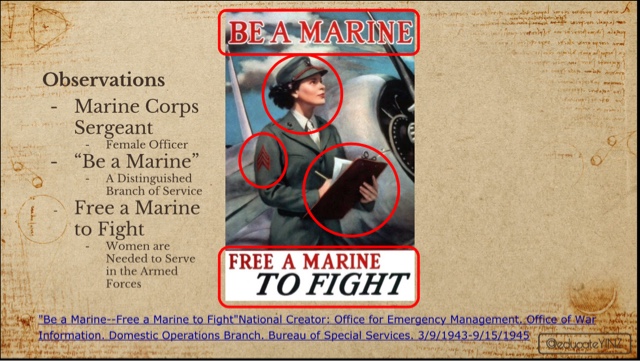
I especially like to use Google Drawings when looking at strong visuals such as advertisements or propaganda. The WWII propaganda poster above is successful in conveying a message with both words and images. 

Highlighting a few key features helps students to focus their attention on the message that is being conveyed via subtle details. This might lead to nuanced observations, such as pointing out the significance of the phrasing and the body language exhibited by Airman Diez.

Once you show your students how much fun it is to analyze primary sources using Google Drawing, it's only a matter of time before they will feel confident enough to create examples of their own. And just like all GAFE, Google Drawing is perfect for working collaboratively. You can track changes and see contributions from all contributors.

At the end of the day, we want to empower our students to take the lead. When our students develop the strength and confidence to take over and teach, we have succeeded as educators.

Friday, January 22, 2016

Design Thinking: Using Persona Profiles to Gain Empathy & Understanding

Persona Profiles are instrumental to gaining empathy & understanding: Luma & Stanford's d-school offer exceptional resources to help teachers begin to use the principles of design thinking in the classroom.

After sharing a few classroom artifacts via Twitter, I was asked to post a few of my lessons in which I used these principles of design thinking in our Cultural Literacy classroom. One of my favorite examples of using design thinking strategies from this first semester of teaching at Holy Family Academy is the 1930s Great Depression Persona Profile project. 

Our Cultural Literacy students studied aspects of American society in the 1930s. This included learning about the "Alphabet Soup of the Works Progress Administration" and reading Clifford Odettes' groundbreaking play, Waiting for Lefty. 


Props to my partner in crime and co-conspirator, Ms. Ro Vigilante for bringing Lefty into our world--tremendously insightful view of life in the 1930s and labor demonstrations integral for ensuring the rights of workers everywhere.

Stakeholder Map - This is the "low-resolution" starting point for our project. We began by thinking of different types of people who would be affected by the economic hardships of The Great Depression. It became evident that the damage inflicted upon American citizens crossed boundaries of class, gender, race, and ethnicity. Everyone was caught-up in the wake of this economic crisis that swept the nation and broader global community.

Demo - WPA Employee: Zora Neale Hurston, Federal Writer's Project
(I taught Zora's "How It Feels To Be Colored Me" for six years as an AP Lang & Comp teacher... I just had to honor her spirit! What an inspiration.)

Demo - Average American Woman
Students really needed to consider factors such as class, gender, race, ethnicity, geography and other social circumstances as they pertained to 1930s American life. Talk about digging into serious social implications of "who we are" and "where we are from".

Student Produced Persona Profiles - The Civilian Conservation Corps (CCC)
Domzy, Mason & Tyrell (The Mayor) created dynamic persona profiles to examine the WPA's affect upon a community in Texas. To achieve their objective, they needed to know information about the mission of the CCC and they had to create a stakeholder map identifying the individuals whom would be affected by this WPA program.

We created an Animoto video as a trailer to inspire other classrooms to try using the principles of human centered design and design thinking in education. Warning: the jazz flute in this video is powerful.

I want to thank #dtk12chat, #BFC530 & #remakelearning for connecting me to a global network of educator-innovators. We are passionate about reforming education: to educate this generation of students for the innovation age. It begins with stoking the fires of learning. 

Our Persona Profiles sparked student curiosity about what it meant to live in the 1930s... How life was radically different for individuals based upon their class, gender, race, ethnicity and other social demographics. It was a tremendous opportunity for growth.

Digital media resources, such as the Depression-Era cartoon "Confidence: Starring FDR & Oswald the Lucky Rabbit", helped my students to connect with a topic as big as the Great Depression. Additionally, this video sparked an intriguing discussion on how cartoons are a perfect medium to convey complex ideas for a wide audience. Children and adults of any age can get something out of the subtle and overt messages within this cartoon from 1933. It is an exemplar text for primary source analysis.

The template for the lesson was designed using Google Apps for Education. This prototype is my first iteration of the project--so, it is nice starting point, but definitely a work in progress. Please pass along your adaptations and ideas for improvement. 

Thursday, January 21, 2016

Field Based Learning: Pittsburgh Writing Marathon

As the Coordinator of Educational & Cultural Affairs at Holy Family Academy, I am honored to facilitate field based learning activities that expand our students' learning ecosystem. I'm like a network orchestrator--my role is partly to organize these events, often to create the instructional resources, and also to bring our partners on board. I love when the learning experiences are organic, moments when the city is our classroom and the students create meaningful experiences by immersing themselves in their community and reflecting upon their world. My favorite field experience from the first semester happened on a picturesque day in early November.

On this day, we embarked upon the North Shore Riverfront Writing Marathon. 
Writing Marathon Google Map - Click the link to access our interactive Google Map

Its easy to create and share interactive adventures for your students to navigate new experiences. Many of our HFA students live within a short distance of these five points of interest. However, how often do we pause to "take in the sights"? Everything that you see was designed using Google Apps for Education, including the interactive map and writing marathon journal. I especially liked the feature that allows you to customize the icons on the map: notice the pencils marking writing marathon waypoints. Dreaming about and designing this trip was almost as much fun as actually taking part in the actual writing marathon.

Adarian reflects upon finding the extraordinary in ordinary "everyday-any day" experiences. The Water Steps, adjacent to PNC Park, are one of the more popular attractions on the North Shore Riverwalk. With the water shut-off on this autumn morning, the steps themselves have become our standing desks in our outdoor classroom.

Point State Park - Pittsburgh, PA
It is a well known fact that I have a natural bias toward all things Pittsburgh... Yet, it's hard to argue that we have one of the most picturesque entrances to any major city in the country. The Point and Pittsburgh's Golden Triangle inspires amateur photographers and provides our HFA students a sanctuary in which to think, write, and dream.

The North Shore Riverwalk between PNC Park and Heinz Field provides our HFA students with ample opportunities to chat with teachers. Moments like this embody our innovative approach to field-based learning. The city is a living, breathing part of our learning ecosystem.

The Mr Rogers statue, overlooking the fountain at Point State Park, sets the backdrop for tranquil moments such as our writing marathon... Mr Rogers also stands vigil over raucous events like Steeler home games: We bleed black and gold in the Steel City!

Henry takes pause and contemplates "The Point: Where three rivers meet the eternal dream of creation." Our HFA students are encouraged to think deeply and write passionately about matters of great importance. It's a personalized approach that helps students to discover who they are in our interconnected world.

I want to thank Mrs. Kristin Alvarez, for she introduced me to the concept of a writing marathon. As you can see, it was a wonderful way to expand the learning ecosystem well beyond the four walls of the classroom. On this day, the City of Pittsburgh was our classroom and muse. As an educator, it was a day that I will never forget. #HFAinnovates

If you would like to take your students on this reflective tour to see experience and write about the Steel City from a unique perspective, download the following guides: