Showing posts with label Maker-Ed. Show all posts

Wednesday, March 21, 2018

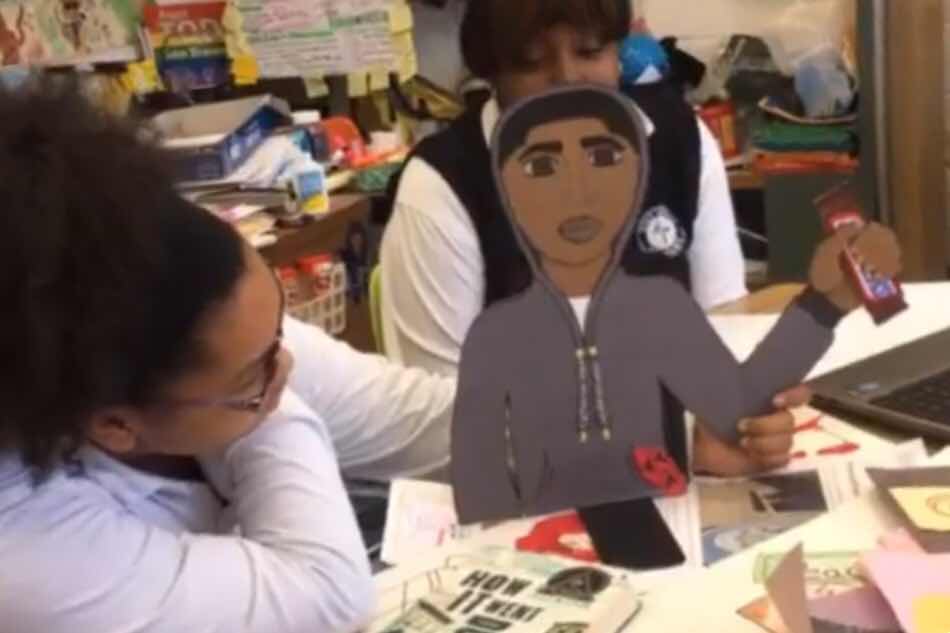
How It Went Down | Empathy Building Robot


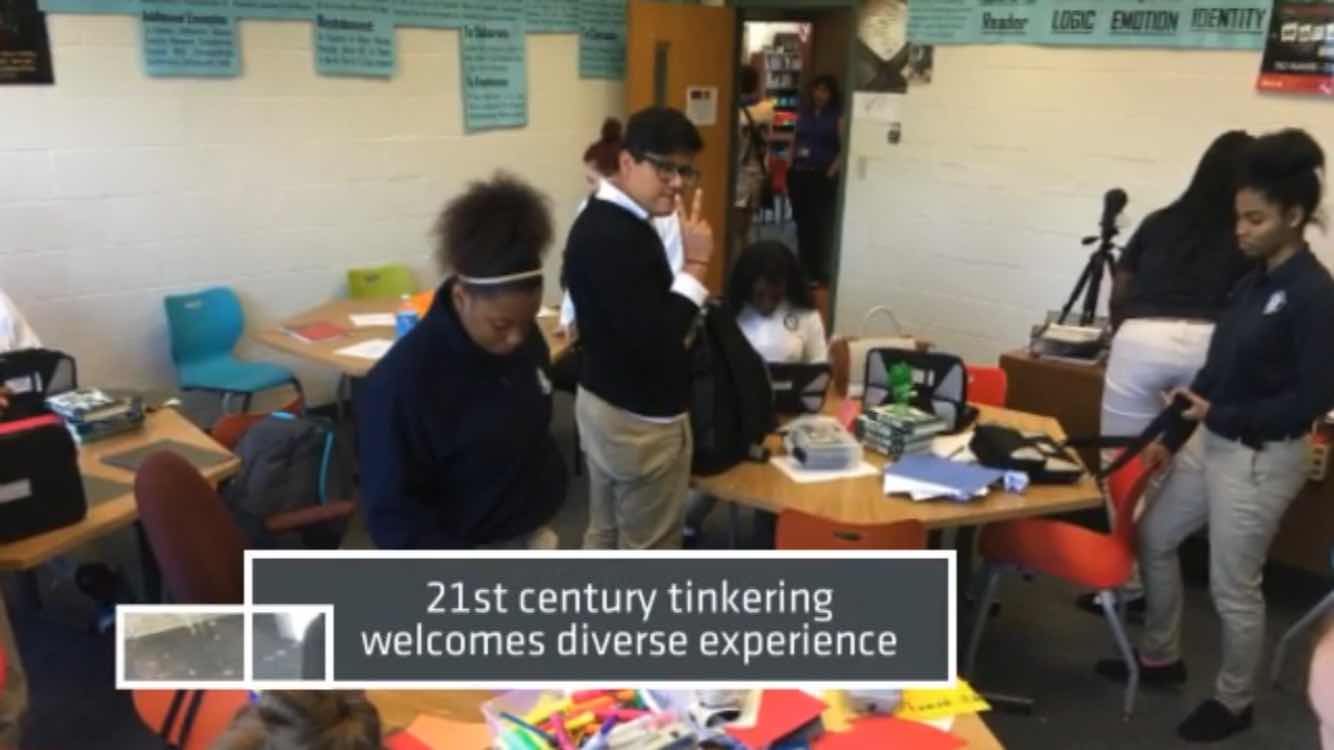
A national dialogue has formed around gun violence, thanks to the efforts of very brave young people. The following video chronicles the story of my students using a maker-ed and design thinking challenge to create an object or performance to start a dialogue around the events and central themes in Kekla Magoon's award winning novel How It Went Down.
My instructional design process leveraged methodologies ranging from the human-centered design practices of the LUMA Institute, visible thinking strategies as outlined by Harvard School of Education's Project Zero, and the process of guided inquiry as articulated by Trev MacKenzie.

Our student products and performances were all inspired by the themes of Magoon's novel, including but not limited to the topics of gun violence, underrepresented communities, criminal justice system reform, racial profiling and the way that statistics (on race and violence) are reported, street art, and so much more.

Students built robots, recorded podcasts, created infographics and other forms of data visualizations, composed slide decks for presentations, and wrote spoken word poetry to share at a whole-school assembly. Inspired by the work of the students articulating their vision, many adults and classmates in other grades requested copies of How It Went Down and thus began an impromptu community book club.

The Fluency Project at Carnegie Mellon University's Community Robotics, Education and Technology Laboratory (CREATE Lab) presented powerful stories on building cultures of community around technology and making. I was honored to present our story as a member of the Fluency Project cohort at YOUMedia in Chicago, Illinois.


Sunday, February 26, 2017

ManyLabs Hosts The Fluency Project: Numbers & Narrative Design Workshop

"Paper-meets-electronics-meets-open-data" is an revolutionary concept fueling San Francisco based NEXMAP. With a mission to provide learners with readily accessible, hands-on experiences that "connect the principles of engineering, systems thinking, and creative expression", NEXMAP's Hack Your Notebook Project and Open Data / Open Minds initiatives open-up a new kind of #FutureReady innovation. It is this type of thinking that aspires to support underrepresented and underserved populations in developing the core competencies of creative confidence, problem-solving, critical thinking, and collaboration.


David Cole introduces the themes for the design-thinking workshop and establishes relationships with members of the Fluency Project on our Bay Area research tour. (Photo Credit: J. Lanas)

Our Fluency cohort and team members met David Cole & Elisabeth Sylvan in the indie-industrial workspace of ManyLabs. As is the legacy of many fabled Bay Area / Silicon Valley start-ups, think-tanks, and entreprenurial incubators, this creative collective calls its home-sweet-home the friendly confines of a garage in San Francisco's dog-friendly Soma neighborhood. After touring all three floors of their facility, including the mindblowing, "data-driven food" aquaponics lab run by Eryk Maundu of Kijani Grows, we initiated our design-thinking workshop.


Eryk Maundu demonstrates how the arduino's sensors transmit nutrient information back to an easy-to-understand computer interface. Kijani Grows is a play on the Swahili word for "green", hence the idea "green grows". (Photo Credit: J. Lanas)

The aptly titled workshop "Numbers and Narrative" was broken-into three segments: a hands-on demo working with paper circuitry, an applied-ideation session facilitated by creative process worksheets (polished and beta-tested), and finally designing for data, or a glimpse into how experimentation and fabrication can lead to students collecting and working with data.


Elisabeth Sylvan emphasizes that science is an iterative process of asking and answering questions. (Photo Credit: J. Lanas)

Three immediate take-aways:

  • ManyLabs and The Fluency Project share common goals around developing "habits of mind" and "fluency" around a "process-oriented" approach to Student Learning, Data Literacy, and Technological Integration.
    • In many instances it becomes almost too easy to become enamored of the technology, or maker-ed tinkering components and lose sight of the learning. A process-oriented approach to learning and constructing meaning with empathy at its core is a safeguard to losing sight of what matters most.


Pigeons vs Seagulls: A prototype fabrication and design project to facilitate student data collection and interpretation. (Photo Credit: B. Slezak)

  • Quick-fix approaches to educational disparities too often throw money and an illusive promise of new technology as a panacea that will cure underperforming schools.
    • Shiny new baubles are not designed to address systemic inequity. A pedagogical shift is necessary to ensure that we are meeting our students' diverse needs and cultivating a culture of curiosity that empowers students to take control of their learning.


Brett, Lauren, and I are simply transfixed as we develop ideas for our own data collection prototypes. (Photo Credit: J. Kaminsky)

  • Sound research and strong practices of teaching and learning drive innovation, civic engagement, and data literacy--not just in the classroom, but in all realms of existence.
    • We are helping to shape and mold the next generation of thought-leaders, innovators, and change agents. We want them to represent all of our communities and to design solutions to problems that they face, to answer burning questions that they have, and above all else, to see the power that they already have as vested stakeholders in our collective future.


How might we build inquiry muscle and cultivate a disposition of critically noticing? Authentic inquiry, case making, and advocacy are central tenants that will remake learning, transforming a system built upon compliance to one that empowers all learners to follow their curiosities. (Photo Credit: J. Lanas)

Wow-- talk about exploring just the tip of the iceberg. There is so much more to come from this site visit and trip as a whole... This is just a first draft reflection while it is fresh in my mind. Already I am envisioning the educational implications of this type of design, fabrication, and data collection process in an interdisciplinary project. I dream of empowering my students in this manner.

My gratitude to our hosts, David and Elisabeth of ManyLabs, as well as the awesome CREATE Lab Fluency team, and my incredible Head of School at Holy Family Academy who pledged her support for me to go on this Bay Area tour.
-Jennifer Lanas #thefluencyproject


21st Century Notebooking (Video Credit: NEXMAP)

Monday, November 21, 2016

Giving Thanks | The Fluency Project: The First Quarter PBL


Despite having just crossed the threshold of the first quarter, our enthusiasm is still pretty infectious. We are entering the time of year that we’ve looked toward with mounting anticipation, and perhaps just a modest amount of apprehension: project proposal and action plan season! Needless to say, everyone in Cultural Literacy III has something to look forward to over the next few weeks.


Cultural Literacy III students at Holy Family Academy are encouraged to explore literature and life… to utilize numbers, narratives, and the arts in order to tell powerful stories. (Photo credit: Jennifer Lanas)

In quarter one, our juniors in Cultural Literacy III (Contemporary American Issues) read Kekla Magoon’s How It Went Down and paired it with close-reading and empathy building techniques. Along with preliminary research and narrative storytelling strategies, our Holy Family Academy students ideated wrestled with real-world issues present in the novel and inspired by their own experiences. In turn, students submitted project proposals ideating upon these issues with the goal of bringing the story to a wider audience, promoting awareness, understanding, and empathy. Ultimately, to become change agents we must first be ambassadors of deeply personal stories inspired by literature and life. 
​


Keshawn is critiquing a proposal using the “think-puzzle-explore” peer-review sheet. Inspired by Agency by Design and Project Zero, this “Think-Puzzle-Explore” method of peer review yielded thoughtful, targeted feedback. (Photo credit: Jennifer Lanas)

To evaluate each other’s work, we adapted a tuning protocol by Agency by Design. It is a systematic way to look at student work and offer feedback to reflective practitioners. My dear friend and colleague, Kristin Alvarez is a member of ABD’s Pittsburgh cohort. When she taught this to our Holy Family Academy teachers, I immediately began thinking of how I might be able to hack it for our Cultural Literacy students to use. The resulting activity yielded some of the best peer-review conferences that I’ve witnessed in my teaching tenure.


Our Holy Family Academy Juniors selected their own topic of exploration and the medium by which they would bring their projects to life. This falls under Trev Mackenzie’s definition of “Guided Inquiry”. (Photo credit: Trev Mackenzie)


Admittedly, it is a challenge facilitating so many different projects among three sections of Cultural Literacy. In a few instances, I am coordinating meetings with teams of students spanning multiple class periods. Moving forward, we are utilizing at least one class period per week (70 minutes) as well as taking advantage of our flexible schedule that gives all juniors a one-hour block of lunch and Independent Learning Time (ILT) three-days per week. Some teams and individuals are more enthusiastic about continuing this process of guided inquiry and project-based-learning than others. These motivated teens are writing podcast scripts, blogging at home, and sketching-out plans for storyboarding mini documentaries or constructing robotics projects. In order to facilitate the project and continue the pacing of our contemporary issues curriculum, we have project benchmarks throughout the month of November and the early part of December. 


Manor New Tech High School located near Austin, Texas is an example of a school pioneering a dynamic PBL model. Their story is featured in this video highlighting PBL success from start-to-finish. We are not quite there, yet… (Photo credit: Education Week / New Tech Network)


I would be a liar if I said that 100% of our students are on-board with this departure from the traditional “culminating project” model that we are all accustomed to. We spend one class period per week studying a mentor text or conducting primary source investigations in addition to the one period that we devote moving forward on our PBL goals. Considering that we only meet three sessions per week, it is imperative that everyone do their collective part to stay focused. I have to be a reflective practitioner and flexible in terms of timing and scheduling. It’s not as though I pitched the project timeline to our juniors and their joyous shouts of approval ensued a celebratory parade down Ohio River Boulevard… Had that occurred, I would request that we ride unicorns and invite sasquatch, chupacabra, and a leprechaun to preside over the festivities.


Botticcelli's Bigfoot will serve as the grand marshall of the parade celebrating teenagers applauding a school initiative that doesn't involve extended vacation and/or the addition of nap pods to the classroom. In all seriousness, my students really seem to enjoy this departure from the ordinary, but it is admittedly more work compared to what they were previously accustomed. (Photo credit: fullfrogmoon.com)


Without a doubt, I consider it a preliminary victory for our students to take control of the story of their learning. They are engaging in deeper learning, becoming experts in the topics that they have selected.  I have become a student in the world that they creating--whereby they are expert researchers and designers of an experience that will educate others. At this phase in the process, our juniors are now looking for an authentic audience to share their work and expert knowledge. I could not possibly be more proud of our students. Needless to say, perhaps I have the most to look forward to and to be thankful for this November.


This post can also be found on #thefluencyproject blog.

Tuesday, March 22, 2016

First Drafts: 1950s American Life YouTube Videos

The critics agree--our 1950s YouTube videos came along nicely. I am encouraged to say the least.
Though our timeframe for production took a little longer than anticipated, we put the finishing touches on this first draft.


Chris, Riley & Chuck - Life in the 1950s, featuring commentary on The Cold War and the emerging Civil Rights Movement


Destiny(Dee Dubs) and Javian on Racism in the 1950s, featuring two teens' perspective on segregation and racism


Kent & Dwayne's take on The Red Scare and links to the Civil Rights Movement

Tuesday, February 2, 2016

Lesson: Students Take Over & Teach WWII History Using Digital Media & Maker-Ed

Students whom create and present media & makerspace projects before an audience are empowered with the creative confidence to make, build, and tell a story that goes far beyond the covers of a dusty history book.


We began with the expertly curated resources available on the National WWII Museum's website. It's loaded with a myriad of primary sources and easy to access and understand secondary sources. I do not have a lexile-level for their PDFs, but I will say that everyone in our learning community used these resources with relative ease, especially when chunking and conducting pair-share check ins.


Our Learning Goal: 

-To make something that would teach an audience, between the ages of 10-110, about WWII - It's was an ambitious, personalized approach that paid off in a big way. The agency the students developed in the making of this project took our classroom to a new level.

-Students browsed the digital archives and used the resources labeled "WWII at a Glance".

-The four topics branch out into mini lessons on more specific events--slices of time that give our students access to the past in a way that they have never been exposed to: to be living participants in WWII history.


Students were encouraged to use the WWII Museum's online collection. However, for special-focus topics, we accessed materials from other institutions, including the Holocaust Museum and the Smithsonian, both in Washington DC.


The most critical part was guiding students to tell the story of how this event or movement might be historically significant. It's tempting, as a teacher, to want to step in... Ample feedback from peers helped to reinforce the message that the WWII Media & Makerspace project was an opportunity for students to "take over and teach". I took notes on the feedback that students received, and passed them along so groups could get started on the next iteration.


The use of templates and agile resources that get students to reflect upon the process of storyboarding and pacing their research and curated content... This is an area that I would like to improve upon in my next iteration. I realized at this phase that I did not establish a set guide or a few options for students to use for this phase of the project. 

My fear was that if I did, it would feel overly scripted--as a worksheet. However, I think that students would have benefitted from seeing the thinking process made visible via agile resources that make us slow down and take pause to reflect and take purposeful action.


I love exercising student voice and choice. The students were free to select their groups, topics, and learning object that they would create. The majority elected to use digital media to make Animoto videos. A handful opted for a more maker-centered approach and crafted memory boxes, scrapbooks, and mobiles. One student even used Tinker CAD to design 3-D printed WWII style propaganda empowering modern women.

It's amazing to see what our students come up with when we get out of the way and equip them with the agency to take over and teach.

Friday, January 29, 2016

Creative Synergy: Good Partners In Crime & Adventures in Curriculum Hacking

Freshly picked ideas are worth climbing to the highest branches. Luckily, we need not always scurry up a tree, but rather we can find inspiration in much closer confines. Today's post is about the brainstorming and spitballing that makes classroom magic happen.


Cultural Literacy at Holy Family Academy

As part of a dynamic duo teaching Sophomore Cultural Literacy at HFA, I work closely with my partner in crime and co-conspirator, Ro Vigilante @vigilantewords. Together, we integrate American literature into the cultural context of 20th century American history and culture. 

This means that the students are truly developing a sense of the world in which they immerse themselves. In a way, we develop a taste for what it was like to live within the world that once was--to test its boundaries and limitations... To tackle it's challenges and embrace it's opportunities. 

For example, our exploration of the 1930s demonstrates a good mix of complimentary content, skills, and dispositions needed for students to connect with the world of the past, and engage the present moment via 21st century skills and design thinking.

Ro selected a bold play, Clifford Odettes Waiting for Lefty. Together we conducted a table read of the play--I thought this was neat on so many levels: Ro has an extensive background in theatre, so the students experienced Ms. Vigilante not just in her teacher costume, but as a real person, passionate about drama and the arts.

On the heels of this discussion, focusing on the nascent labor movement, a push to unionize, and the plight of young people facing a bleak and uncertain future, we transitioned to the Works Progress Administration and the Alphabet Soup programs designed to get us out of the Great Depression. 

Instead of focusing on content alone as in a traditional history class, we looked closely at the principles of human centered design and embarked upon a collective journey--project based learning and role play. Our students explored the way both the Depression and WPA affected the lives of real Americans. 

Want to learn more? Check out my blog post on using the principles of design thinking to develop Depression Era persona profiles. There's a groovy YouTube video of student perspectives on the making of the persona profiles, too.

The tech skills that we acquired using GAFE and our knowledge of the Depression helped students to build persona profiles. This also helped us to focus our attention on the disposition critical to being a good amateur historian: empathy. 

After students shared their work and posted their persona profiles to our learning management system, they recorded reflections discussing the critical need for empathy when embarking upon a venture such as this. Our students really developed context spanning the bounds of time, geography, race, ethnicity, and socioeconomic status. Where else could all of this be possible but in Cultural Literacy, an integrated classroom.

Inspiration comes in many forms... It helps to have a good partner and to work at an innovative school that empowers teachers to have the creative confidence to "go for it" and take their moonshot ideas from the drawing board to the classroom. Needless to say, I have rediscovered my teaching vocation at HFA this year.


At my former school and alma mater, Trinity High School, I worked closely with a cohort of teachers whom happened to be my lunch buddies, too. In a public school, there are fewer opportunities to modify the curriculum, unless you get the chance to write curriculum. 

I took advantage of this offer when designing the curriculum for AP Lang & Comp a few years back. Last year I shifted gears again, when I jumped at the chance to incorporate 21st century tech and active learning strategies in the 9th Grade Academy. This lead to a bit of curriculum hacking and creative use of resources to build a low resolution Makerspace in my classroom. 

First, it should be noted that freshmen are in a precarious state of knowing all of the answers and being terrified that they will be exposed for not having all of the answers... They are miniature versions of the juniors and seniors that I taught for years, only more malleable. I jest... But with lots of elements of the truth.

In the 9th grade academy, there were no opportunities to rewrite curriculum, but as previously reported, plenty of chances to "hack-curriculum " existed. For instance, Vonnegut's Harrison Burgeron was teamed up with NPR stories about an autistic classroom and their iPad band... The classic short story The Most Dangeroous Game was coupled with a podcast on street violence and a gang of teenagers on Long Island profiling and hunting Latino youth.

My students, predominantly Middle-class teens living in a rural suburb of Pittsburgh, were transfixed. Their ability to make relevant connections to both fiction and the new media that I presented them with skyrocketed. From here, we began to supplement the existing curriculum with digital media that highlighted the relevance of the text. It was 9th grade English remixed and reimagined... 

The addition of digital media and relevant, real world content transformed a short story unit into a decisive turning point in our classroom--to work within the confines of curriculum and Common Core Standards familiar to all public school teachers, but find ways to remake learning for our students.

Again, it goes back to having good partners--people that you can trust with your both your heart and your thoughts: because for teachers, we live a thousand lives within our classrooms, and the spillover into our personal world has few boundaries. 

Case in point: I keep tablets and post its around the house (and in my car's cup holder) to jot down ideas for school--I happen to be blogging at the stove on a Friday night, seasoning a pot of chili...but duty calls! 

Yes, and... It comes down to this: To be a teacher is to be fully alive in your vocation. For you and your students are on a path of learning and discovery; it was written in the eternal dream of God. Your mission is to author that story for future generations. A future of wonder and possibility.

Thanks for looking back with me... 
There are so many of my former colleagues that I wish to thank--and maybe that will be a post down the line. But I really want to tip my cap to special Ed teacher and my partner for over 4 years Jen Rakoczy, my best friend across the hall and Empress of Empathy Diana Denman, my Chewba writing creative consultant Swarrow, my Pirate game companion and the golden voice of Trinity Athletics Matt White, my difference-maker/ keeper of perspective and Frida Khalo fan club president Marna Day, my trifecta of oracles of insights at the far end of the school Erin Helmkamp, Nicole Welch, and Gretchen Mountain, my history pals who always encouraged me to brainstorm about World Affairs Council and to bridge the gaps and help students make the connections between our two fields--Mary Ellen Jutca , Joe Dunn, Lou Majoris--and my carpool partner and rogue educator in constant search of ways to improve educational practice and get kids to actually speak another language "German Josh" Baringer, aka Herr Bear.

These folks, as well as a huge cast of characters from all over the district, helped me to brainstorm some of the most interesting and creative projects for our students. I loved my time at Trinity and I grew so much as a watched eight classes of students graduate... I am forever grateful.

So, find your tribe--in your department, in your school, in your world. Next week, I'll write about online PLNs via Twitter.
Wednesday, January 20, 2016

Autograph Your Work with Pride: e-Portfolio Midterm in Cultural Literacy

It's important to take pride in a job well-done--and today was a veritable celebration of our hard work and accomplishments in Cultural Literacy. Here are some snapshots of the projects that students completed and showcased in their e-Portfolio midterms.

WWII Makerspace and Media Projects

Tyrell, Mason, & Fekens - Tuskegee Airmen Memory Box


Chuck's Pearl Harbor Timeline


Kent & Dwayne: Holocaust Animoto Video (with music sampled from a popular WWII video game)

Dominic's 3-D printer Tinker Cad Prototype: WWII Propaganda Remixed & Re-Imagined for a New Millennium

Syanne's Anne Frank & Family Memory Box

Student Video Reflections


Zack on Using Animoto to make his Pearl Harbor digital media project


Lakin on The Strength of African American Women in WWII


Destiny on the Changes Affecting African American Women on the Homefront

Kent & Dwayne on Personalized Learning: Choosing your own Topic & Media/Maker-Ed Product

Monday, January 18, 2016

Project Zero Pittsburgh: Learning w/ Ron Richhart & Jessica Ross (Agency by Design)

Today was Project Zero Pittsburgh #pz_pgh. I worked with colleagues from schools across southwestern Pennsylvania in today's event at Quaker Valley. We collaborated on ways to make thinking visible--it was enlightening. My immediate take-away from a professional development conference as this is to become a more mindful practitioner of the art of teaching...

Additionally, I've found my way back to the blog! I took a (brief*) hiatus after leaving my post of eight school years  at my alma mater, Trinity Area, and accepting my new position as a Cultural Literacy teacher at Holy Family Academy, an innovative independent Catholic school in Pittsburgh. Needless to say, this has been a year of immense personal & professional growth--I count myself most fortunate, indeed. I will have a number of stories to share in the coming weeks...

For now, though, let's just say that it's good to be back on the blog!

In response to a request from my new friend, Charles @sf_k5enrichment, I've posted my #SketchNotes from #pz_pgh. 

Enjoy!
-Jennifer Lanas
@educateYINZ

Ron Richhart's Keynote Address


Jessica Ross' on The Promises & Practices of Maker-Centered Learning

Ron Ritchhart on Language, Discourse, & Questioning

Huge thanks to Jeff Evancho & Quaker Valley School District for hosting today's event!

Tuesday, May 26, 2015

Maker-Ed - Tell Their Side of the Story

#Maker-Ed Project
"Tell Their Side of The Story"

Awesome work in the 9th grade Academy Makerspace

-Maker-Ed works in English Language Arts

Check out a few glimpses of student works in process...

Arnold: From Bodybuilder to Governator

CiCi & Chelsea proudly display their artifacts

Angelina Jolie: Actress & Humanitarian

Maker-Ed has a place in the humanities! We need more educator-innovators to embrace the maker movement. Our students need these precious opportunities to make, build, and create.

@educateYINZ