Showing posts with label Teacher Resources. Show all posts

Thursday, February 25, 2016

Tech Tips: Update - Class Dojo REALLY Works in Learning Hub

Nearly one month has passed since we introduced Class Dojo to shape-up our morning routines. I'm pleased to announce the success of our venture! Initially greeted with suspicion, our sophomores took less than a week to buy-in.

Now, Class Dojo has become part of our morning routine. Students are rewarded for being prompt, productive, and positive. 

The introduction of these videos helped, too:

Growth mindset: training your brain!

Our learning hub students connected with the cartoon avitars introducing us to class dojo. This includes Mojo, the adorable little guy orbiting the earth, pictured above.


Growth mindset: the magic of making mistakes

The intro videos teach lessons on how to develop a growth mindset. This includes forming the habits, skills, and dispositions necessary to be successful in school and in life.

To incentivize the process, as our students earn dojo points, they qualify for small rewards--cheese sticks, juice boxes, and little healthy snacks.

Contrary to their latest protest, I don't think offering potato chips will get them into Learning Hub faster...

Here's to your health, kids!

-j

Tuesday, February 23, 2016

Lesson: The American Dream Deferred - The 1950s African American Experience

Digital media and primary sources from the Montgomery Bus Boycott introduce our students to the civil rights movement in America. As historical problem solvers, we joined the ranks of Dr. Martin Luther King Jr and Rosa Parks--as well as Claudette Colvin, Bayard Rustin, Jo Ann Robinson, and Virginia Foster Durr... Names we may not (yet) know, but probably should.


We began our inquiry (historical problem solving) with two pivotal questions:

1) "What might this poster suggest about the people and organizations behind the Montgomery Bus Boycott?"

2) "How might an act of civil disobedience, like breaking an unjust law, spark a nationwide movement?"

A demanding challenge and a hard-fought victory:

The students' responses were thought-provoking and very well reasoned. Their ability to cite specific evidence is emerging, and as our exercise continued, they confidently referenced details from both the bus boycott flier as well as Rosa Parks' booking photo and accompanying question.

It gave me such pride to share this experience with our students' corporate work study supervisors--approximately twelve visitors happened to be on tour while we were discussing the warm-up questions and image above.

The ensuing scene was inspiring, magical, and reminiscent of a Morgan Freeman movie about a school "turning lives around and opening hearts in the process". The students and their supervisors took turns playing off of each other, bringing up points about the style of the poster, the size of the font, the homemade details... Truly, it was one of those moments that make you feel the electricity that comes from engaging in the learning process. 

Our students collaborated in groups of up to three people, working through a textbook entry (A) and four additional primary sources (B-E). 

In each round, they constructed a claim addressing the question "Why was the Montgomery Bus Boycott successful?"

To answer this, our students needed to cultivate reasons that the artifact used to suggest that the protesters would prevail and specific evidence that they could cite in support of their claim.

Again, working with primary sources poses a far greater challenge than textbook entries, as students must construct meaning and place the ideas within a historical context. It's a sophisticated task that requires patience, skill, and above all else, practice.

I'm incredibly proud of our students and the work that they have accomplished. It gives me joy to share this lesson with you in the hopes that you may find the inspiration to work with primary sources and integrate this Monthomery Bus Boycott playlist into your class, too.

Digital media: 


Curriculum & teacher resources:


- Google HyperDoc: MBB Notes
(links to primary and secondary sources)

On the horizon:

Our students will begin production of YouTube videos about 1950s American life. We are collaboratively constructing claims, sourcing the best digital media and primary source evidence to support the assertions, and we will roll out our first iterations in the week to follow. It's incredible to witness how far we have come in this short amount of time together.

Invaluable resources:

@SHEG_Stanford
@PSNTPS
@TeachingLC
@librarycongress
@pbsteachers

Thursday, February 18, 2016

Tech Tips: Advanced Search Techniques Help Students to Get the Most from Googling

Advanced search techniques are yet another #AwesomePossum way that Google helps teachers and students find and curate content.

A few years back, we used Google Image look-up to track down the artist behind the Possum with Ukulele. The artist gave us permission to use the design for our high school's anti-bullying assembly, and the little guy has been either ever since. I'm a big fan of AwesomePossums.

A few ways that advanced search techniques can be used include placing restrictions on an active search. These restrictions can be a variety of factors used to distill the best results for whatever the circumstance dictates.

-Date

-File type

-Region

-Creative Commons and other copyright licenses


Here are some helpful links to get started 

Advanced search for websites & images:

Tips on filtering search results:

Finding "free-to-use" images:

Next week, I will update this post with a YouTube tutorial using some of the advanced search techniques listed above.

-

I'm looking forward to teaching our students how to use the filters to curate images for their 1950s American Life YouTube video project. Cultural Literacy students will begin making annotated YouTube videos about the different themes that we have explored:

-The Cold War & The Red Scare

-American Consumerism & Women in the 1950s

-The American Dream Deferred: Segregation & The Start of the Civil Rights Movement

-j

Wednesday, February 17, 2016

Find Your Tribe: Celebrating Digital Learning Day - #DLDay

To mark #DLDay 2016 I'm sharing "super" Twitter chats. Far from a definitive list--Think of this as a PLN on-demand: no superhero costume necessary.


Spider-Man, Sprout, & Lanas... Now there's a formidable crew! Holy dangling modifier, Batman! We rapidly prototype our way to justice and stop to SketchNote the bad guys for the real crime fighters.

A Definitive List of Twitter Education Chats & Days/Times:


Some of my favorites:

#bfc530 - A Daily Dose of PD & Inspiration

#dtk12chat - Design Thinking in Education

#2pencilchat - Innovative Ideas, Analog Tools = Celebration of Creativity

#tlap - Teach Like A Pirate 

#totallyrossome - Off the Wall Communal Celebration of Learning

#sschat - Social Studies Chat

*#sstlap - Social Studies Teach Like a Pirate... I just learned about this today via reading last night's archived #totallyrossome

#libchat - Librarians & Information Science for the Digital Age

#edtechbridge - Bringing Ed Tech Developers & Teachers Together

#badgechatk12 - Digital Badges in Education

#sunchat - Sunday AM PD

#ditchbook - Toss Out Your Expensive Textbook & Opt For Digital Media & Tools 

#aplangchat - AP English Language & Composition

#aussieed - Aussie Ed Chat

Some of these chats occur way too late (or early, mates!) for a high school teacher sleeping/waking on Eastern Standard Time...

But that's the beauty of Twitter: Conversations are archived using the hashtag. So, I'm more likely to participate in #bfc530 or #2pencilchat... But I find myself reading the highlights from the previous night's #tlap or #drk12chat the very next day.

The key is to find your tribe!


Tuesday, February 16, 2016

Lesson: 1950s American Life & The Happy Housewife Archetype (+YouTube Playlist)

The past is a foreign country--historical inquiry requires a passport unlike any other: stamped with empathy, understanding, the willingness to believe that many actions were guided by well-meaning intentions, and some decisions are shrouded in ignorance. 
It is what it is. And in the study of Cultural Literacy, the past comes to life as we devour novels, primary sources, and historical accounts from experts in the field.


This past week, we continued our investigation of 1950s American life and focused on "The American Dream". Our inquiry centered upon American consumerism and the role of women in the 1950s.


Our sophomores responded to this lively discussion. It was another impressive display of teenagers grappling with the foreign-nature of historical inquiry. On more than one occasion, debate turned to pondering the legitimacy of gender stereotypes of the time and the silent dissatisfaction among many in the 1950s. 

One of our awesome sophomores, Leah, sent me a music video from the band the Neighbourhood. Her observations, that the dissatisfaction and turmoil of the homemaker in the video, resembles the discontent voiced in the Feminine Mystique and other primary sources that we examined.

Classroom Resources:
Stanford History Education Group: Reading Like A Historian
Primary Source Readings: Women in the 1950s

Videos:
Cultural Literacy Class Playlist - 1950s American Life: American Consumerism & Women
Makers: Women Who Make America (PBS) - 1950s Housewives

Collaborative HyperDoc: 

Two primary sources:

Two secondary sources:

Additional Video Resources:


USA Economy in the 1950s

The Feminine Mystique via PBS Makers: Women Who Make America

The Levittown Story - America's First Working Class Suburb


Crisis in Levittown - Segregation and Discrimination

The hyperdoc and resources from Reading Like a Historian are great for collaborative learning across the spectrum... appropriate for learners of varying reading levels.
-j

Tuesday, February 9, 2016

Lesson: Sketchnoting The Cold War & An Introduction To Audience Awareness

Recently I was overjoyed to share with my students a mutual affection for sketchnotes and Soviet era art and propaganda. I should preface this post by sharing that once upon a time, I felt the wrath of a a handful teachers growing frustrated with my unorthodox style of note taking... 

I'm not claiming that kids like me were persecuted for busting-out the multi-colored pens to take notes, draw pictures and charts, and jazz-up an extra few sheets of wide-rule filler-paper. We were just misunderstood... And, what we once referred to as doodling in our notebooks has now found legitimacy in today's classroom: Awesome Possum! 

A student's sketchnote of Churchill's "Iron Curtain Speech".

I like to read speeches aloud--they are meant to be savored by the ear. I really like coupling this delivery method with the processing that sketchnotes afford. Think about it: the act of slowing down to incorporate both words and images helps students to personalize the lesson and make the take-away a very unique experience for every learner in the classroom. 


The materials for this lesson came from the unit "Cold War Culture" via Stanford History Education Group's Reading Like a Historian series. I will dedicate a future post to singing their praises--the resources are spectacular.

Above, we used an excerpt from Churchill's speech. The full text is available online--just register for a free account on the Stanford History Education Group's site. The readings come with accompanying guides, too. I incorporated the questions from the guides and used them to supplement class discussion. 

I especially liked the way that the questions prepared by SHEG focused upon audience-awareness. This is a sophisticated step for students to make--the jump from "What is Churchill saying?" to "Why is he saying it this way?" or "Why is Churchill addressing an American audience in the first place?"

The benefit of introducing a sophisticated notion such as audience awareness in tandem with a seemingly juvenile technique as sketchnoting is that the student drawn images can help to articulate this difficult concept--that the substance of a speech is only part of the equation... It's the audience's ability to receive that message that is telling.

A thoughtful illustration can bring that concept to light in a way that a developing writers' voice is still sounding-out.

To complete the analysis, I created a Google Doc note taking sheet... Because sketchnoting all four primary sources would be just too much of a good thing.

The sheet above is appropriate for individual efforts and collaborative endeavors, as with all GAFE resources. If you plan to have your students work in cooperative learning groups, dividing the readings is a must:
-Documents A & B suggest that the Soviets are primarily responsible for starting the Cold War
-Documents C & D suggest that the US shoulders the burden for starting the Cold War


Hope you check out both sketchnotes & Stanford History Education Group's resources!

-Jennifer Sylves Lanas

Note:
In hindsight, my doodles were not taboo in every single subject when I was in school. I recall making a cartoon series in high school starring my AP Bio teacher as a studio wrestler our entire class named "The (protein) Inhibitor, and his collection of side-kicks from the lab--including a cameo appearance by the fabled Three Little Pigs... And who could forget the comics I drew and posted in the Saint Vincent College Philosophy Tutor's office--Philososaurus Rex...

Lesson: Be kind to those students who color outside the lines.
You might end up reading their blog one day...

Tuesday, February 2, 2016

Lesson: Students Take Over & Teach WWII History Using Digital Media & Maker-Ed

Students whom create and present media & makerspace projects before an audience are empowered with the creative confidence to make, build, and tell a story that goes far beyond the covers of a dusty history book.


We began with the expertly curated resources available on the National WWII Museum's website. It's loaded with a myriad of primary sources and easy to access and understand secondary sources. I do not have a lexile-level for their PDFs, but I will say that everyone in our learning community used these resources with relative ease, especially when chunking and conducting pair-share check ins.


Our Learning Goal: 

-To make something that would teach an audience, between the ages of 10-110, about WWII - It's was an ambitious, personalized approach that paid off in a big way. The agency the students developed in the making of this project took our classroom to a new level.

-Students browsed the digital archives and used the resources labeled "WWII at a Glance".

-The four topics branch out into mini lessons on more specific events--slices of time that give our students access to the past in a way that they have never been exposed to: to be living participants in WWII history.


Students were encouraged to use the WWII Museum's online collection. However, for special-focus topics, we accessed materials from other institutions, including the Holocaust Museum and the Smithsonian, both in Washington DC.


The most critical part was guiding students to tell the story of how this event or movement might be historically significant. It's tempting, as a teacher, to want to step in... Ample feedback from peers helped to reinforce the message that the WWII Media & Makerspace project was an opportunity for students to "take over and teach". I took notes on the feedback that students received, and passed them along so groups could get started on the next iteration.


The use of templates and agile resources that get students to reflect upon the process of storyboarding and pacing their research and curated content... This is an area that I would like to improve upon in my next iteration. I realized at this phase that I did not establish a set guide or a few options for students to use for this phase of the project. 

My fear was that if I did, it would feel overly scripted--as a worksheet. However, I think that students would have benefitted from seeing the thinking process made visible via agile resources that make us slow down and take pause to reflect and take purposeful action.


I love exercising student voice and choice. The students were free to select their groups, topics, and learning object that they would create. The majority elected to use digital media to make Animoto videos. A handful opted for a more maker-centered approach and crafted memory boxes, scrapbooks, and mobiles. One student even used Tinker CAD to design 3-D printed WWII style propaganda empowering modern women.

It's amazing to see what our students come up with when we get out of the way and equip them with the agency to take over and teach.

Thursday, January 28, 2016

Tech Tips: Using Class Dojo To Shape-Up Our Morning Routines

Mornings are tough enough as it is... But try being a teenager. Yikes. Good thing my colleagues introduced me to Class Dojo.

To a teenager, it must feel as though mornings are fraught with pitfalls and there is an adult around every corner, reminding teens of the 1,001 ways that they are not doing what they need to do in order to be successful. It can be overwhelming and these morning mishaps take a toll on our students. 

We need to remind our students that nobody is perfect. That we all make mistakes. That we really do learn from our mistakes... Or so we can, with the right mindset and specific guidance. 

Class Dojo is a tool providing immediate feedback that students need. With "tips and props", our students can develop the executive skills to make better, well-informed choices.

Awarding points for the right attitudes, skills, and disposition is critical. Notice above, my greatest challenges were kids not getting their day started properly--being on time, having their laptops, etc. I just made these two behaviors a little more enticing on our point scale. So far, so good.

It is also important to steer our students in the right direction--a course correction, if you will. Think about it, how many "blow-ups" and "melt-downs" and "is it time for dismissal, yet?" moments from students and teachers butting-heads... Having the same conflicts, repeatedly making the same mistake. As "Mojo" and his friend said, "mistakes can be a good thing". 

There is awesome power and responsibility when using Class Dojo--so think it out before you dive-in with your students. Personally, I believe that the key is to focus on behaviors and routines--these are the types of things that we can change, with time and practice. As you can see, the only over-lap between my "positives" and "needs work" is when it comes to students bringing and using their laptops in Learning Hub. Here's why:

Since I flipped my class and put all of my readings and digital media resources into online modules, I want to encourage students to have their laptops in Learning Hub, whether they need them or not. 

So, if students are working on their laptops, checking email and Canvas (our learning management system) they earn two points. 
If they have their laptops but aren't doing those things, their point total stays the same. 
If a student doesn't bring  a laptop, then it becomes an issue... Because it will be an issue for my students when it's time to go to their first period class.

The classroom videos that accompany Class Dojo are entertaining and truly amusing. Kudos to their animators and designers--it's fun to watch.

So, the students are giving me feedback on an incentive-based point scale. I'm open to awarding healthy snacks and fidget-toys from the dollar bin... For everybody in our Learning Hub, it's a win-win!

Big props to Dr Roberta Brandao & Mr Nick Bridge, my personal Class Dojo ambassadors!

Tuesday, January 26, 2016

Lesson: Writing w/ PEEL - Analyzing Primary Sources

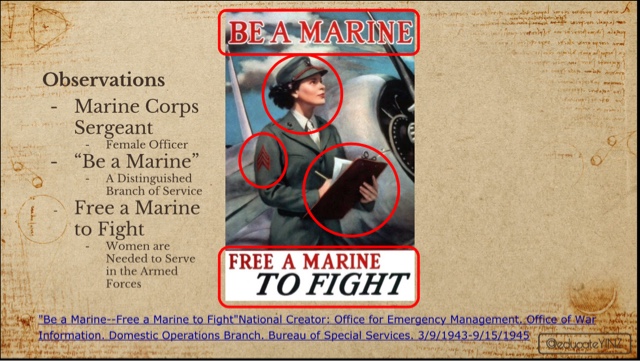
Solid analysis begins with students focusing on the "point" or purpose of the text that they are examining. I like to use the PEEL method to help novice writers get to the heart of the matter.

Learning to observe and critically reflect upon details in primary sources is integral to making inferences. In turn, this leads to students developing the confidence and skill to develop strong claims.

Check out some of the observations that our students made.

This works with PEEL paragraphs and can easily be adapted for other forms of creative expression.

Check out the templates below. The focus of these propaganda posters deal primarily with women in WWII


Friday, January 22, 2016

Design Thinking: Using Persona Profiles to Gain Empathy & Understanding

Persona Profiles are instrumental to gaining empathy & understanding: Luma & Stanford's d-school offer exceptional resources to help teachers begin to use the principles of design thinking in the classroom.

After sharing a few classroom artifacts via Twitter, I was asked to post a few of my lessons in which I used these principles of design thinking in our Cultural Literacy classroom. One of my favorite examples of using design thinking strategies from this first semester of teaching at Holy Family Academy is the 1930s Great Depression Persona Profile project. 

Our Cultural Literacy students studied aspects of American society in the 1930s. This included learning about the "Alphabet Soup of the Works Progress Administration" and reading Clifford Odettes' groundbreaking play, Waiting for Lefty. 


Props to my partner in crime and co-conspirator, Ms. Ro Vigilante for bringing Lefty into our world--tremendously insightful view of life in the 1930s and labor demonstrations integral for ensuring the rights of workers everywhere.

Stakeholder Map - This is the "low-resolution" starting point for our project. We began by thinking of different types of people who would be affected by the economic hardships of The Great Depression. It became evident that the damage inflicted upon American citizens crossed boundaries of class, gender, race, and ethnicity. Everyone was caught-up in the wake of this economic crisis that swept the nation and broader global community.

Demo - WPA Employee: Zora Neale Hurston, Federal Writer's Project
(I taught Zora's "How It Feels To Be Colored Me" for six years as an AP Lang & Comp teacher... I just had to honor her spirit! What an inspiration.)

Demo - Average American Woman
Students really needed to consider factors such as class, gender, race, ethnicity, geography and other social circumstances as they pertained to 1930s American life. Talk about digging into serious social implications of "who we are" and "where we are from".

Student Produced Persona Profiles - The Civilian Conservation Corps (CCC)
Domzy, Mason & Tyrell (The Mayor) created dynamic persona profiles to examine the WPA's affect upon a community in Texas. To achieve their objective, they needed to know information about the mission of the CCC and they had to create a stakeholder map identifying the individuals whom would be affected by this WPA program.

We created an Animoto video as a trailer to inspire other classrooms to try using the principles of human centered design and design thinking in education. Warning: the jazz flute in this video is powerful.

I want to thank #dtk12chat, #BFC530 & #remakelearning for connecting me to a global network of educator-innovators. We are passionate about reforming education: to educate this generation of students for the innovation age. It begins with stoking the fires of learning. 

Our Persona Profiles sparked student curiosity about what it meant to live in the 1930s... How life was radically different for individuals based upon their class, gender, race, ethnicity and other social demographics. It was a tremendous opportunity for growth.

Digital media resources, such as the Depression-Era cartoon "Confidence: Starring FDR & Oswald the Lucky Rabbit", helped my students to connect with a topic as big as the Great Depression. Additionally, this video sparked an intriguing discussion on how cartoons are a perfect medium to convey complex ideas for a wide audience. Children and adults of any age can get something out of the subtle and overt messages within this cartoon from 1933. It is an exemplar text for primary source analysis.

The template for the lesson was designed using Google Apps for Education. This prototype is my first iteration of the project--so, it is nice starting point, but definitely a work in progress. Please pass along your adaptations and ideas for improvement. 

Thursday, January 21, 2016

Field Based Learning: Pittsburgh Writing Marathon

As the Coordinator of Educational & Cultural Affairs at Holy Family Academy, I am honored to facilitate field based learning activities that expand our students' learning ecosystem. I'm like a network orchestrator--my role is partly to organize these events, often to create the instructional resources, and also to bring our partners on board. I love when the learning experiences are organic, moments when the city is our classroom and the students create meaningful experiences by immersing themselves in their community and reflecting upon their world. My favorite field experience from the first semester happened on a picturesque day in early November.

On this day, we embarked upon the North Shore Riverfront Writing Marathon. 
Writing Marathon Google Map - Click the link to access our interactive Google Map

Its easy to create and share interactive adventures for your students to navigate new experiences. Many of our HFA students live within a short distance of these five points of interest. However, how often do we pause to "take in the sights"? Everything that you see was designed using Google Apps for Education, including the interactive map and writing marathon journal. I especially liked the feature that allows you to customize the icons on the map: notice the pencils marking writing marathon waypoints. Dreaming about and designing this trip was almost as much fun as actually taking part in the actual writing marathon.

Adarian reflects upon finding the extraordinary in ordinary "everyday-any day" experiences. The Water Steps, adjacent to PNC Park, are one of the more popular attractions on the North Shore Riverwalk. With the water shut-off on this autumn morning, the steps themselves have become our standing desks in our outdoor classroom.

Point State Park - Pittsburgh, PA
It is a well known fact that I have a natural bias toward all things Pittsburgh... Yet, it's hard to argue that we have one of the most picturesque entrances to any major city in the country. The Point and Pittsburgh's Golden Triangle inspires amateur photographers and provides our HFA students a sanctuary in which to think, write, and dream.

The North Shore Riverwalk between PNC Park and Heinz Field provides our HFA students with ample opportunities to chat with teachers. Moments like this embody our innovative approach to field-based learning. The city is a living, breathing part of our learning ecosystem.

The Mr Rogers statue, overlooking the fountain at Point State Park, sets the backdrop for tranquil moments such as our writing marathon... Mr Rogers also stands vigil over raucous events like Steeler home games: We bleed black and gold in the Steel City!

Henry takes pause and contemplates "The Point: Where three rivers meet the eternal dream of creation." Our HFA students are encouraged to think deeply and write passionately about matters of great importance. It's a personalized approach that helps students to discover who they are in our interconnected world.

I want to thank Mrs. Kristin Alvarez, for she introduced me to the concept of a writing marathon. As you can see, it was a wonderful way to expand the learning ecosystem well beyond the four walls of the classroom. On this day, the City of Pittsburgh was our classroom and muse. As an educator, it was a day that I will never forget. #HFAinnovates

If you would like to take your students on this reflective tour to see experience and write about the Steel City from a unique perspective, download the following guides: