Showing posts with label Social Emotional Learning. Show all posts

Wednesday, March 21, 2018

How It Went Down | Empathy Building Robot


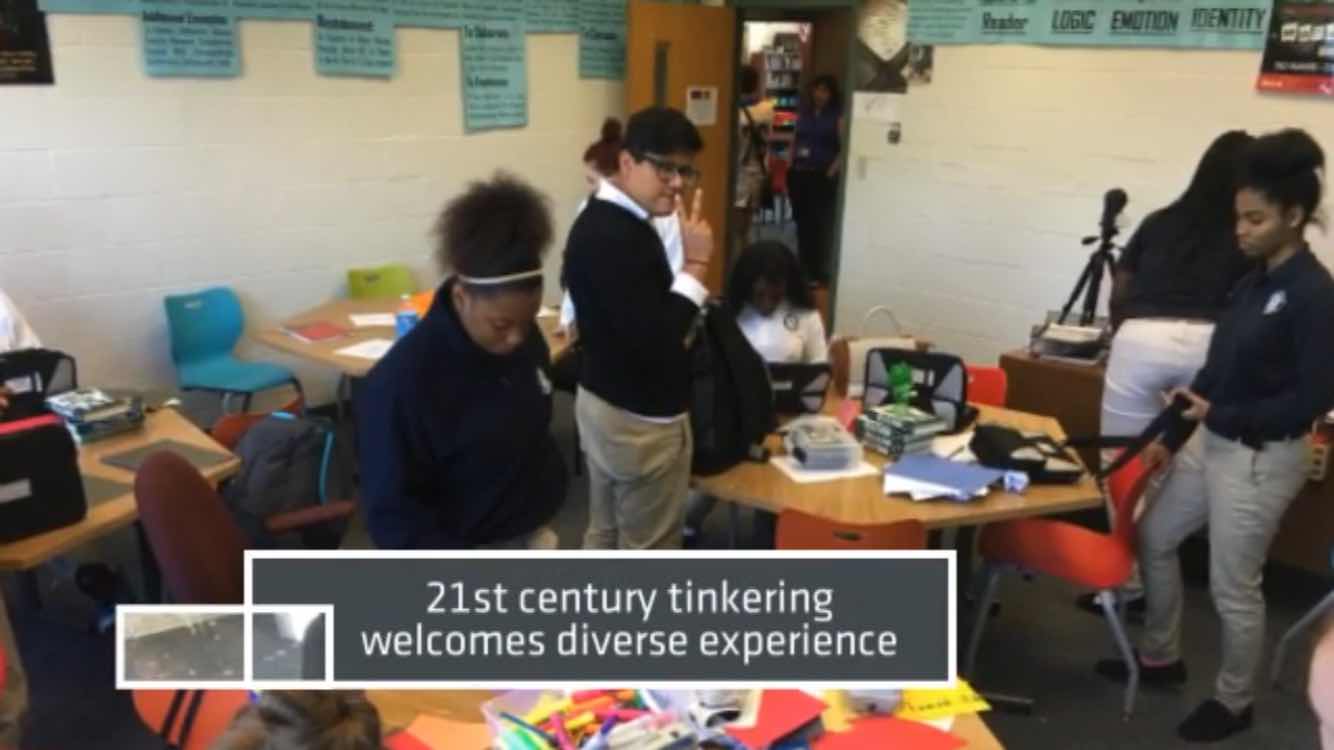
A national dialogue has formed around gun violence, thanks to the efforts of very brave young people. The following video chronicles the story of my students using a maker-ed and design thinking challenge to create an object or performance to start a dialogue around the events and central themes in Kekla Magoon's award winning novel How It Went Down.
My instructional design process leveraged methodologies ranging from the human-centered design practices of the LUMA Institute, visible thinking strategies as outlined by Harvard School of Education's Project Zero, and the process of guided inquiry as articulated by Trev MacKenzie.

Our student products and performances were all inspired by the themes of Magoon's novel, including but not limited to the topics of gun violence, underrepresented communities, criminal justice system reform, racial profiling and the way that statistics (on race and violence) are reported, street art, and so much more.

Students built robots, recorded podcasts, created infographics and other forms of data visualizations, composed slide decks for presentations, and wrote spoken word poetry to share at a whole-school assembly. Inspired by the work of the students articulating their vision, many adults and classmates in other grades requested copies of How It Went Down and thus began an impromptu community book club.

The Fluency Project at Carnegie Mellon University's Community Robotics, Education and Technology Laboratory (CREATE Lab) presented powerful stories on building cultures of community around technology and making. I was honored to present our story as a member of the Fluency Project cohort at YOUMedia in Chicago, Illinois.


Wednesday, March 2, 2016

Video Pick: Carol Dweck's Growth Mindset - An RSA Animated Talk

Developing a growth mindset entails developing a predisposition to learn constantly and continuously. Carol Dweck's extensive research in this field leads the way in our investigation of what it means to develop a growth mindset.

In this animated talk, Dweck investigates the effects of praising intelligence vs. process.


A few items to take-away:

1) Praising intelligence leads children to develop a fixed mindset...

Thus, a student grows to believe that s/he is "smart" or "dumb" when it comes to a certain academic subject or skill that s/he is in the process of developing.

2) Astonishingly, praising intelligence turns kids off to learning...

Furthermore, these children often reject the chance to learn in favor of the chance to do well at something much less challenging.

3) Those praised for the process overwhelmingly want to take-on hard tasks...

Undaunted by momentary setbacks, these students work-through challenges, remain confident, and often enjoy tackling problems

This video features Harry Potter All Stars... not too shabby!
-j

Thursday, February 25, 2016

Tech Tips: Update - Class Dojo REALLY Works in Learning Hub

Nearly one month has passed since we introduced Class Dojo to shape-up our morning routines. I'm pleased to announce the success of our venture! Initially greeted with suspicion, our sophomores took less than a week to buy-in.

Now, Class Dojo has become part of our morning routine. Students are rewarded for being prompt, productive, and positive. 

The introduction of these videos helped, too:

Growth mindset: training your brain!

Our learning hub students connected with the cartoon avitars introducing us to class dojo. This includes Mojo, the adorable little guy orbiting the earth, pictured above.


Growth mindset: the magic of making mistakes

The intro videos teach lessons on how to develop a growth mindset. This includes forming the habits, skills, and dispositions necessary to be successful in school and in life.

To incentivize the process, as our students earn dojo points, they qualify for small rewards--cheese sticks, juice boxes, and little healthy snacks.

Contrary to their latest protest, I don't think offering potato chips will get them into Learning Hub faster...

Here's to your health, kids!

-j

Friday, February 19, 2016

Small School, Big Heart: Our First Pep Rally & School Spirit

An innovative school for families of any means, welcoming students from every neighborhood in Pittsburgh's metropolitan area... We are a diverse community of learners. We are proud. We are just getting started.
We celebrated the coming of the final game of the season by hosting a pep rally.

Students and teachers competed in various athletic and academic events--all in the name of fun. Winner takes bragging rights, and a few incentives:

-Dress down day
-Pajama day
-Sports team jersey day
-Pizza party 

The best part about these incentives, other than the fact that they won't break the bank, is that the students came up with the prizes themselves. They made this day a success!

Students emceed the event, coordinated schedules, and ran the sound system. The amount of elbow grease that went into this event was a sight to see. It was a celebration of our school community. Mrs. Alvarez (seated to the right) organized the event as part of Integrated Studies' team 3 project to increase school spirit.

Our administrators got in on the action and battled for a hard fought victory against our students. Knock-out is a serious sport!

The three-legged-relay provided awkward fun for participants and a spectacle for spectators, alike. Finding and hitting your stride are two distinct things...

Volleyball provided some tense moments and spirited debate between the students and faculty. It was a close match, but in the end the teachers squeaked out a victory.

Final thoughts:

We are a small school with limited resources, but the imagination that went into making our first pep rally a success came from a limitless supply of inspiration. It's the desire to be one--to bring our community together and celebrate that which makes us unique, extraordinary... 

We are Holy Family Academy: a start-up school educating teens to be contributors to the world in which they live, work, and play. I'm proud to be a part of this community.

Monday, February 15, 2016

A Quick Video Pick: Brené Brown & RSA Animate's Empathy Bear

Developing an empathic capacity for understanding is one of our greatest challenges and most urgent needs. To cultivate this disposition is critical to solving the big issues facing humanity in today's society and in the future.


Brené Brown's TED Talk has been transformed into an enchanting animated short, courtesy of the RSA.

Following the trials and tribulations of a little fox, a nosey deer, and our new friend, empathy bear, Brown's insights are accessible for a younger teenage audience and delightful for audiences of all ages.

Brown does not shy away from taboo topics such as profound loss and depression. She uses characters such as the little fox and empathy bear to plumb to the depths of sadness and show how it is often reliance on each other that ameliorates a wounded heart and spirit. 

Her words are simple, yet speak a profound truth--"I know what it's like down here. And you're not alone." This is a delightful three minute video that can be used in class, as a springboard in a social-emotional learning program, or as an inducement to warm fuzzies any day of the week.


Enjoy!
-j

Friday, February 12, 2016

Mindfulness: A Meditation On Self-Care & The Perogi Race Of Life

Kindness, a form of weakness; Rest, a sign of laziness: An intolerant worldview as unhealthy and fraught with misunderstanding as I've ever heard. As commonplace as sliced bread. Modern life may be hazardous to your health!

What we need is a reminder that life is a marathon and not a sprint. That the perogi race is more than just a single inter-innings break in a Pirate game, but rather culminates in an entire season of home games at PNC Park...

We need to take time to breathe, to follow our curiosity, to unplug and pursue our passions--if we are lucky enough to have found them.

I'm guilty of ignoring my body's signals to slow down--to administer self-care and to just observe. Certainly as a teacher, I'm not alone in neglecting these important things that we sometimes feel are impossible to find time for... My goodness: Have you seen the size of my to-do list?

Meanwhile, the evidence is overwhelming that a little mindfulness goes a long way. Whether it is incorporating a meditative breathing exercise like anapana respiration--not altering ones breath, but just observing the natural flow of respiration, or practicing a few minutes of gentle stretching and restorative yoga, finding time for self care can be a difference maker.

Lately, my morning routine is supplemented by a light YouTube yoga session and a #bfc530 chat. I feel these two additions to the start of the day make a tremendous difference in my mindset throughout the day. 

Not as often as I would like, I try to wrap up my day with a short meditation session--an almost impossible feat. Aside from not budgeting my time as well as I would like and almost always running a deficit at the end of a long day, I am human. I would rather read a little while longer, or try to squeeze "just one more thing" into an already full evening, just for the sake of crossing it off of that all-consuming to-do list.

However, on nights that I meditate, I find myself drifting off to sleep faster, waking with clarity, and finding calm at the bookends of my dreams.

I wonder if this is something that I could teach to others--a way of gaining perspective by pulling the plug. A way of approaching everything differently, not by doing anything. 

When we just observe, we learn so much about ourselves and the world in which we live.

Let us be mindful that we need to set aside time for self-care. When our batteries are recharged, we can better serve our students and inspire creativity and imagination.


Wednesday, February 3, 2016

In Search of Human Origins: How A Middle School Librarian Made Me Who I Am Today

If I were judged by "the person I was as a kid", I would likely not be a teacher... And had an adolescent version of me gazed into a crystal ball, she would be surprised to find her calling as an educator.


"A Tale of Two Jennys" 
- Above, reading Dr. Seuss stories to my Pound Puppies...
-Below, celebrating the "catch of the day" along Ten Mile Creek in Amity, PA

This photo was taken when I was in first grade... Notice the frilly purple jacket, camouflage hat, and stringer of rainbow trout: An average childhood snapshot, growing up in Western Pennsylvania...

Teachers have the privilege of numbering their years upon this planet by their number of years in school--as students, as undergrads, as professionals... Each passing year, an opportunity to connect with yet another group of young minds. Impressionable youth, with malleable ideas and enthusiasm... Dreamers and doers, each writing their own drama of existence. And remember--to a teenager, the drama is oh so real.

As I am rereading Tony Wagner's MOST LIKELY TO SUCCEED, I noticed something that I must have glossed over in my first read. Both Wagner and Dintersmith take a moment to thank a very special teacher--someone who made school a place where each student felt welcome, felt like they belonged, felt like they mattered.

For me, that could be so many people who have touched my life. However, I am thinking in particular of a librarian that took me under her wing when I was an awkward middle schooler.

Her name was Mrs.Hackett--and she saved my life.
Okay, that might be a bit dramatic. But I believe it with all sincerity. 

I just love this photo--I'm in fifth grade basking in college life with my oldest brother, on campus at Johns Hopkins University in Baltimore, MD. My right arm is in my coat because I recently saw a painting of Napoleon and it just seemed like the most logical pose to strike.

Mrs. Hackett knew that my oldest brother was away at school, and I missed my hero and friend. My other brother (who would later join the ranks of hero/friend--but just not at this age... we still fought like close siblings tend to do) was in high school and was too busy learning to play the guitar to pay very much attention to me. 

Mrs. Hackett lured me to the library with the siren song of books--all the books that I could get my hands on. She even Interlibrary-Loaned a few books from college and university collections: I had a fascination with the Nova series In Search of Human Origins and I wanted to read everything that was published in English. If a hominid was involved, I was up for the challenge.

So, there I was--in sixth and seventh grade--carrying college texts on paleoanthropology, writing faux newspaper articles about epic discoveries in Olduvai Gorge by Don Johansen, and dreaming of working in the Institute of Human Origins in Berkley, CA. I rode that momentum through middle school. It carried me into high school and college--where I no longer envisioned myself a budding paleoanthropologist, but definitely had an affinity for biology.

It all began with Mrs. Hackett...

This is an awkward Middle School Math Counts team photo, taken in eighth grade. My friend Tina still looks exactly the same, by the way. Lucky lady.


It should be noted that Mrs. Hackett tricked me. Seriously, it was for my own good--here's the story:

As a sixth grader, wasting away in an end of the day study hall, a totally unproductive exercise in futility--it was nap time for exhausted girls going through growth spurts--I received a message to go to the library. That was the day that Mrs. Hackett introduced me to a new student who just moved to the US from Poland. I was appointed to be his chemistry tutor.

"But, I don't have chemistry--I don't know how to do this?" I said as I looked up from the table, sitting alongside the smiling newcomer, happy to have escaped his study hall, too.

"Well, I guess you will have to learn it in order to teach it..." Oh--she was crafty, the old girl! So, that's what I did...

My goodness, as a teacher, that's what I do. Isn't that what we all strive to do? To be the lead learners in our classrooms and beyond? To plant the seeds of imagination and creativity into fertile minds--so they may grow into curious, lifelong learners.

It took a few twists and turns for me to find the path that lead to obtaining my masters and teaching certificate... But when I did find myself right where I always belonged, I applied for a graduate work study position in the place where I felt most at home:

I was a "Book Fairy" in the Interlibrary Loan Department and it paid for my tuition. Aside from what I do today, it was the greatest job a ragamuffin like me could ever have.

Mrs. Hackett was definitely on to something...
Thursday, January 28, 2016

Tech Tips: Using Class Dojo To Shape-Up Our Morning Routines

Mornings are tough enough as it is... But try being a teenager. Yikes. Good thing my colleagues introduced me to Class Dojo.

To a teenager, it must feel as though mornings are fraught with pitfalls and there is an adult around every corner, reminding teens of the 1,001 ways that they are not doing what they need to do in order to be successful. It can be overwhelming and these morning mishaps take a toll on our students. 

We need to remind our students that nobody is perfect. That we all make mistakes. That we really do learn from our mistakes... Or so we can, with the right mindset and specific guidance. 

Class Dojo is a tool providing immediate feedback that students need. With "tips and props", our students can develop the executive skills to make better, well-informed choices.

Awarding points for the right attitudes, skills, and disposition is critical. Notice above, my greatest challenges were kids not getting their day started properly--being on time, having their laptops, etc. I just made these two behaviors a little more enticing on our point scale. So far, so good.

It is also important to steer our students in the right direction--a course correction, if you will. Think about it, how many "blow-ups" and "melt-downs" and "is it time for dismissal, yet?" moments from students and teachers butting-heads... Having the same conflicts, repeatedly making the same mistake. As "Mojo" and his friend said, "mistakes can be a good thing". 

There is awesome power and responsibility when using Class Dojo--so think it out before you dive-in with your students. Personally, I believe that the key is to focus on behaviors and routines--these are the types of things that we can change, with time and practice. As you can see, the only over-lap between my "positives" and "needs work" is when it comes to students bringing and using their laptops in Learning Hub. Here's why:

Since I flipped my class and put all of my readings and digital media resources into online modules, I want to encourage students to have their laptops in Learning Hub, whether they need them or not. 

So, if students are working on their laptops, checking email and Canvas (our learning management system) they earn two points. 
If they have their laptops but aren't doing those things, their point total stays the same. 
If a student doesn't bring  a laptop, then it becomes an issue... Because it will be an issue for my students when it's time to go to their first period class.

The classroom videos that accompany Class Dojo are entertaining and truly amusing. Kudos to their animators and designers--it's fun to watch.

So, the students are giving me feedback on an incentive-based point scale. I'm open to awarding healthy snacks and fidget-toys from the dollar bin... For everybody in our Learning Hub, it's a win-win!

Big props to Dr Roberta Brandao & Mr Nick Bridge, my personal Class Dojo ambassadors!