Solid analysis begins with students focusing on the "point" or purpose of the text that they are examining. I like to use the PEEL method to help novice writers get to the heart of the matter.
Learning to observe and critically reflect upon details in primary sources is integral to making inferences. In turn, this leads to students developing the confidence and skill to develop strong claims.
Check out some of the observations that our students made.
This works with PEEL paragraphs and can easily be adapted for other forms of creative expression.
Check out the templates below. The focus of these propaganda posters deal primarily with women in WWII
Annotating primary sources with Google Drawings is an excellent tool for focusing classroom discussion and zeroing in on in-depth analysis. Students are drawn to words and images in a way that is sure to spark imaginative debate and inspire original thought.
Let's get started by familiarizing ourselves with Google Drawing, one of the lesser appreciated Google Apps for Education #GAFE.
Google Drawing is more than "MS Paint" for the new millennium--though I was known to rock the paint back in the days of Windows 95, "Buddy Holly", and a 28.8 modem. When it comes to performance, we look to Google as a standard bearer. Drawing measures up, for sure.
For instance, the ability to search for images and/or add images by inserting a url makes this user friendly and intuitive. Again, we would expect nothing less from GAFE and this app certainly delivers.
Once your image is in the drawing, editing the visual is a breeze. Shapes, circles, arrows & call-outs can be made with just a few clicks.
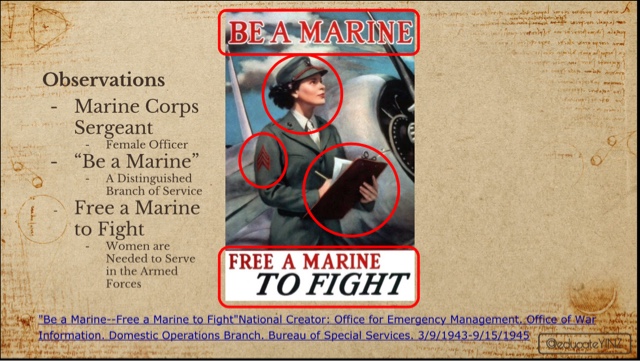
I especially like to use Google Drawings when looking at strong visuals such as advertisements or propaganda. The WWII propaganda poster above is successful in conveying a message with both words and images.
Highlighting a few key features helps students to focus their attention on the message that is being conveyed via subtle details. This might lead to nuanced observations, such as pointing out the significance of the phrasing and the body language exhibited by Airman Diez.
Once you show your students how much fun it is to analyze primary sources using Google Drawing, it's only a matter of time before they will feel confident enough to create examples of their own. And just like all GAFE, Google Drawing is perfect for working collaboratively. You can track changes and see contributions from all contributors.
At the end of the day, we want to empower our students to take the lead. When our students develop the strength and confidence to take over and teach, we have succeeded as educators.
Persona Profiles are instrumental to gaining empathy & understanding: Luma & Stanford's d-school offer exceptional resources to help teachers begin to use the principles of design thinking in the classroom.
After sharing a few classroom artifacts via Twitter, I was asked to post a few of my lessons in which I used these principles of design thinking in our Cultural Literacy classroom. One of my favorite examples of using design thinking strategies from this first semester of teaching at Holy Family Academy is the 1930s Great Depression Persona Profile project.
Our Cultural Literacy students studied aspects of American society in the 1930s. This included learning about the "Alphabet Soup of the Works Progress Administration" and reading Clifford Odettes' groundbreaking play, Waiting for Lefty.
Props to my partner in crime and co-conspirator, Ms. Ro Vigilante for bringing Lefty into our world--tremendously insightful view of life in the 1930s and labor demonstrations integral for ensuring the rights of workers everywhere.
Stakeholder Map - This is the "low-resolution" starting point for our project. We began by thinking of different types of people who would be affected by the economic hardships of The Great Depression. It became evident that the damage inflicted upon American citizens crossed boundaries of class, gender, race, and ethnicity. Everyone was caught-up in the wake of this economic crisis that swept the nation and broader global community.
Demo - WPA Employee: Zora Neale Hurston, Federal Writer's Project
(I taught Zora's "How It Feels To Be Colored Me" for six years as an AP Lang & Comp teacher... I just had to honor her spirit! What an inspiration.)
Demo - Average American Woman
Students really needed to consider factors such as class, gender, race, ethnicity, geography and other social circumstances as they pertained to 1930s American life. Talk about digging into serious social implications of "who we are" and "where we are from".
Student Produced Persona Profiles - The Civilian Conservation Corps (CCC)
Domzy, Mason & Tyrell (The Mayor) created dynamic persona profiles to examine the WPA's affect upon a community in Texas. To achieve their objective, they needed to know information about the mission of the CCC and they had to create a stakeholder map identifying the individuals whom would be affected by this WPA program.
We created an Animoto video as a trailer to inspire other classrooms to try using the principles of human centered design and design thinking in education. Warning: the jazz flute in this video is powerful.
I want to thank #dtk12chat, #BFC530 & #remakelearning for connecting me to a global network of educator-innovators. We are passionate about reforming education: to educate this generation of students for the innovation age. It begins with stoking the fires of learning.
Our Persona Profiles sparked student curiosity about what it meant to live in the 1930s... How life was radically different for individuals based upon their class, gender, race, ethnicity and other social demographics. It was a tremendous opportunity for growth.
Digital media resources, such as the Depression-Era cartoon "Confidence: Starring FDR & Oswald the Lucky Rabbit", helped my students to connect with a topic as big as the Great Depression. Additionally, this video sparked an intriguing discussion on how cartoons are a perfect medium to convey complex ideas for a wide audience. Children and adults of any age can get something out of the subtle and overt messages within this cartoon from 1933. It is an exemplar text for primary source analysis.
The template for the lesson was designed using Google Apps for Education. This prototype is my first iteration of the project--so, it is nice starting point, but definitely a work in progress. Please pass along your adaptations and ideas for improvement.
As the Coordinator of Educational & Cultural Affairs at Holy Family Academy, I am honored to facilitate field based learning activities that expand our students' learning ecosystem. I'm like a network orchestrator--my role is partly to organize these events, often to create the instructional resources, and also to bring our partners on board. I love when the learning experiences are organic, moments when the city is our classroom and the students create meaningful experiences by immersing themselves in their community and reflecting upon their world. My favorite field experience from the first semester happened on a picturesque day in early November.
On this day, we embarked upon the North Shore Riverfront Writing Marathon.
Its easy to create and share interactive adventures for your students to navigate new experiences. Many of our HFA students live within a short distance of these five points of interest. However, how often do we pause to "take in the sights"? Everything that you see was designed using Google Apps for Education, including the interactive map and writing marathon journal. I especially liked the feature that allows you to customize the icons on the map: notice the pencils marking writing marathon waypoints. Dreaming about and designing this trip was almost as much fun as actually taking part in the actual writing marathon.
Adarian reflects upon finding the extraordinary in ordinary "everyday-any day" experiences. The Water Steps, adjacent to PNC Park, are one of the more popular attractions on the North Shore Riverwalk. With the water shut-off on this autumn morning, the steps themselves have become our standing desks in our outdoor classroom.
Point State Park - Pittsburgh, PA
It is a well known fact that I have a natural bias toward all things Pittsburgh... Yet, it's hard to argue that we have one of the most picturesque entrances to any major city in the country. The Point and Pittsburgh's Golden Triangle inspires amateur photographers and provides our HFA students a sanctuary in which to think, write, and dream.
The North Shore Riverwalk between PNC Park and Heinz Field provides our HFA students with ample opportunities to chat with teachers. Moments like this embody our innovative approach to field-based learning. The city is a living, breathing part of our learning ecosystem.
The Mr Rogers statue, overlooking the fountain at Point State Park, sets the backdrop for tranquil moments such as our writing marathon... Mr Rogers also stands vigil over raucous events like Steeler home games: We bleed black and gold in the Steel City!
Henry takes pause and contemplates "The Point: Where three rivers meet the eternal dream of creation." Our HFA students are encouraged to think deeply and write passionately about matters of great importance. It's a personalized approach that helps students to discover who they are in our interconnected world.
I want to thank Mrs. Kristin Alvarez, for she introduced me to the concept of a writing marathon. As you can see, it was a wonderful way to expand the learning ecosystem well beyond the four walls of the classroom. On this day, the City of Pittsburgh was our classroom and muse. As an educator, it was a day that I will never forget. #HFAinnovates
If you would like to take your students on this reflective tour to see experience and write about the Steel City from a unique perspective, download the following guides:
It's important to take pride in a job well-done--and today was a veritable celebration of our hard work and accomplishments in Cultural Literacy. Here are some snapshots of the projects that students completed and showcased in their e-Portfolio midterms.
How might we HOOK our kids on LEARNING? Encourage intellectual curiosity in & out of the classroom.
This past July, to mark the one-year anniversary of the Ice Bucket Challenge, I tweeted the PEEL template that I developed for our Tuesdays With Morrie unit. Click the link below to download a PDF.
Mary Cantwell @scitechyedu proceeded to chat with me, as I tagged the tweet #dtk12chat. Mary & my Head of School, Dr.LisaAbel-Palmieri @learn21tech, founded the #dtk12chat. I'm indebted to Mary, even though she nearly gave me heatstroke... We'll talk about that later. She offered insights and advice for effectively implementing this technique--HMW...
"The 4th word is critical", she remarked. It's true, too: just look at how limiting and scripted my "Ice Bucket Challenge" template appears--full of words like "game-change" and specifics such as "social media campaign" or "fight against terminal disease". Sure--I developed it for a very specific part of a unit. But in doing so, I inadvertently put limits on my students' creativity.
This was "just-in-time" intervention. As I spent my summer traveling between Pittsburgh and Chicago, returning from the Active Learning Summit hosted by Lisa, I was in the right frame of mind to self-evaluate. Mary's observations challenged and inspired me. I had become so engrossed in our conversation, I accidentally got off the red line at the wrong stop. Trust me--an added two mile walk in +90* heat couldn't even slow down my momentum.
I love Pittsburgh... I'm a "Pittsburgh Girl"... But, my goodness--public transit in Chicago is just incredible. We have much to learn, Steel City.
Big Take-Aways:
I did not realize that July's Active Learning Summit would inspire me to resign my position of nearly eight school years and take on the role of Cultural Literacy teacher at an innovative start-up high school founded in the tradition of Catholic schooling for urban youth and families of any means.
I did not realize that a Twitter brainstorming session would lead me to question and redevelop so much of my digital portfolio.
I did realize, though, on that hot-hot afternoon, that we need to be brave enough to look in the mirror and critically take stock of our work. To accept that the iterative process is ongoing and will have necessary setbacks and failures along the way. These missteps are not deal breakers, but on the contrary they are moments of exponential growth. Personally and professionally... If we allow them to be.
I completed a class in Computational Thinking, too. Talk about a truly inspired summer--quality time to push myself as a teacher and lifelong learner.
I've posted a few templates below--some are in varying stages of the iterative process. By no means am I an expert--but I want to share my work to help you to find your best work in and out of the classroom, too. Let's encourage each other and motivate one another!
The key, I believe, is to use conditional language as much as possible... Let's not lock our students into looking for one solution, but encourage free thinking in all of its varying forms. We can hook our kids on learning by creating relevant and thought-provoking discussion starters and writing prompts that tap into cultural movements. So, let the iterative process begin!
Templates:
PEEL + image/INFOGRAPHIC + writing prompt (PEEL = point, explanation, evidence, link to main idea)
Today was Project Zero Pittsburgh #pz_pgh. I worked with colleagues from schools across southwestern Pennsylvania in today's event at Quaker Valley. We collaborated on ways to make thinking visible--it was enlightening. My immediate take-away from a professional development conference as this is to become a more mindful practitioner of the art of teaching...
Additionally, I've found my way back to the blog! I took a (brief*) hiatus after leaving my post of eight school years at my alma mater, Trinity Area, and accepting my new position as a Cultural Literacy teacher at Holy Family Academy, an innovative independent Catholic school in Pittsburgh. Needless to say, this has been a year of immense personal & professional growth--I count myself most fortunate, indeed. I will have a number of stories to share in the coming weeks...
For now, though, let's just say that it's good to be back on the blog!
In response to a request from my new friend, Charles @sf_k5enrichment, I've posted my #SketchNotes from #pz_pgh.
Enjoy!
-Jennifer Lanas
@educateYINZ
Ron Richhart's Keynote Address
Jessica Ross' on The Promises & Practices of Maker-Centered Learning
Ron Ritchhart on Language, Discourse, & Questioning
Huge thanks to Jeff Evancho & Quaker Valley School District for hosting today's event!